
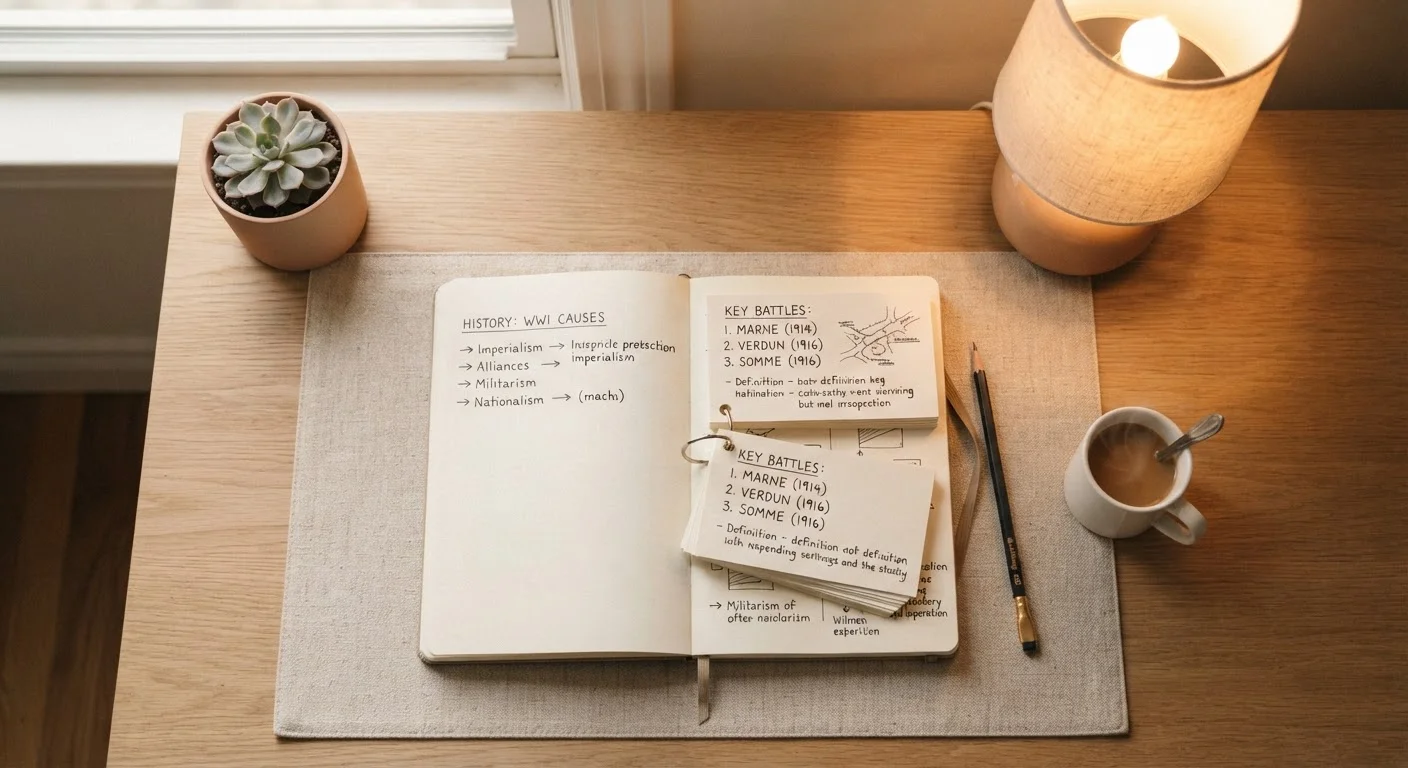
Why Most Studying Doesn't Stick
Most people study the way they were taught by default: read the material, highlight key sentences, review their notes the night before a test. The problem is that cognitive science research consistently shows these passive strategies produce shallow, short-lived memory. Information crammed in one sitting tends to fade within days.
The reason comes down to the forgetting curve - a concept from memory research showing that without reinforcement, newly learned information decays rapidly. Passive re-reading feels productive but rarely forces the brain to work hard enough to build durable memory traces.
Two techniques stand out in the research for actually fighting this curve: spaced repetition and active recall. They are simple to understand, require no expensive tools, and can be adapted to almost any subject. This guide explains both from the ground up. For a broader look at how focused effort differs from passive habit, see deliberate practice vs. casual repetition.
What Is Spaced Repetition?
Spaced repetition is a study schedule that spreads reviews of the same material across increasing time intervals. Instead of studying a topic intensively for one day and moving on, you revisit it after one day, then three days, then a week, then a month - adjusting based on how well you remembered it each time.
The logic is straightforward: reviewing material just as you are about to forget it forces your brain to reconstruct the memory, which strengthens it. Each successful retrieval pushes the next review further into the future.
Forgetting curve
The pattern by which newly learned information fades from memory over time if it is not reviewed. The steepest drop happens in the first 24 hours after learning.
Spaced repetition
A study method that schedules reviews of material at increasing time intervals, targeting review just before you are likely to forget it.
Active recall
The practice of retrieving information from memory - such as answering a question without looking at notes - rather than passively re-reading or highlighting.
Testing effect
The research-backed finding that attempting to retrieve information strengthens memory more than additional study or re-reading of the same material.
Retrieval practice
A broader term for any study activity that involves pulling information from memory, including self-quizzing, practice tests, and the Feynman Technique.
In practice, spaced repetition is often implemented with flashcard systems. Physical cards divided into labeled review piles (today, tomorrow, this week, next week) work well for beginners. Digital tools automate the scheduling based on your self-reported recall quality for each card.
The core habit to build is showing up for short, regular sessions rather than long, infrequent ones. A 15-minute daily review is substantially more effective than a two-hour session once a week for the same material.
What Is Active Recall?
Active recall means deliberately retrieving information from memory rather than passively re-exposing yourself to it. The distinction is important: looking at a flashcard answer is passive; covering the answer and trying to produce it before flipping is active recall.
Research in cognitive psychology refers to this as the testing effect - the well-replicated finding that the act of retrieval itself strengthens memory, independent of additional study time. You don't just check whether you know something; the attempt to recall actually helps you know it better afterward.
Make Recall Harder on Purpose
Introducing a small delay before flipping a flashcard - even just a few seconds of genuine effort - increases the memory benefit compared to checking immediately. This is sometimes called 'desirable difficulty.' The struggle to retrieve is the mechanism that makes recall practice effective, so resist the urge to flip too quickly.
Common active recall methods include:
- Flashcard self-testing - covering the answer side and reciting before checking
- The blank page method - closing your notes and writing down everything you remember about a topic
- Practice questions - working through past exam questions or self-generated quizzes
- The Feynman Technique - explaining a concept aloud in simple terms as if teaching it
Any method that forces your brain to produce information, rather than simply recognize it, qualifies. These habits tie directly into broader learning science. See habits that support learning for how retrieval practice fits alongside other evidence-backed routines.
How to Use Both Techniques Together
Spaced repetition and active recall are most powerful when combined. The method is straightforward:
- Create your material. Write concise flashcards or questions - one idea per card, phrased so you have to retrieve an answer, not just recognize one.
- Test yourself first. Before looking at the answer, attempt to recall it. This is the active recall step.
- Rate your recall honestly. Did you remember it easily, with effort, or not at all? This rating determines when you review that card next - that is the spaced repetition step.
- Schedule short sessions daily. Even 10-15 minutes of consistent review compounds significantly over weeks.
Together, the techniques address two separate problems: active recall ensures each review is effortful and memory-building rather than passive, while spaced repetition ensures you review at the right moment to maximize retention per unit of study time.
Which Subjects Benefit Most
These techniques are particularly well suited to content where you need to reliably remember discrete facts, definitions, or procedures:
- Language learning - vocabulary, grammar rules, and verb conjugations are classic flashcard territory
- Sciences and medicine - terminology, classifications, drug mechanisms, and anatomical structures
- Professional certifications - legal definitions, financial regulations, coding syntax, and industry standards
- History and social sciences - dates, events, key figures, and cause-and-effect relationships
They are less suited to skills that are primarily procedural or creative - like painting or improvised performance - though even those domains often have foundational knowledge components (music theory, color relationships) where the techniques apply.
If you are building a broader learning routine, consider how study habits fit alongside your physical and lifestyle habits. Consistent energy and focus are prerequisites for effective recall sessions - a topic explored in movement habits that support consistency.
Start with one subject you are actively studying right now. Create ten flashcards, test yourself on them today and tomorrow, and adjust your schedule from there. Building the habit small is the most reliable path to making it last.