
Why Standard Budgets Break Down for Variable Earners
Most popular budget templates assume you know exactly how much money is coming in each month. For a salaried employee, that assumption holds. For freelancers, gig workers, part-timers, and seasonal employees, it rarely does.
When income swings from $1,200 one month to $3,800 the next, plugging numbers into a fixed template produces a budget that is either too tight to sustain or too loose to protect you. The framework itself becomes the problem.
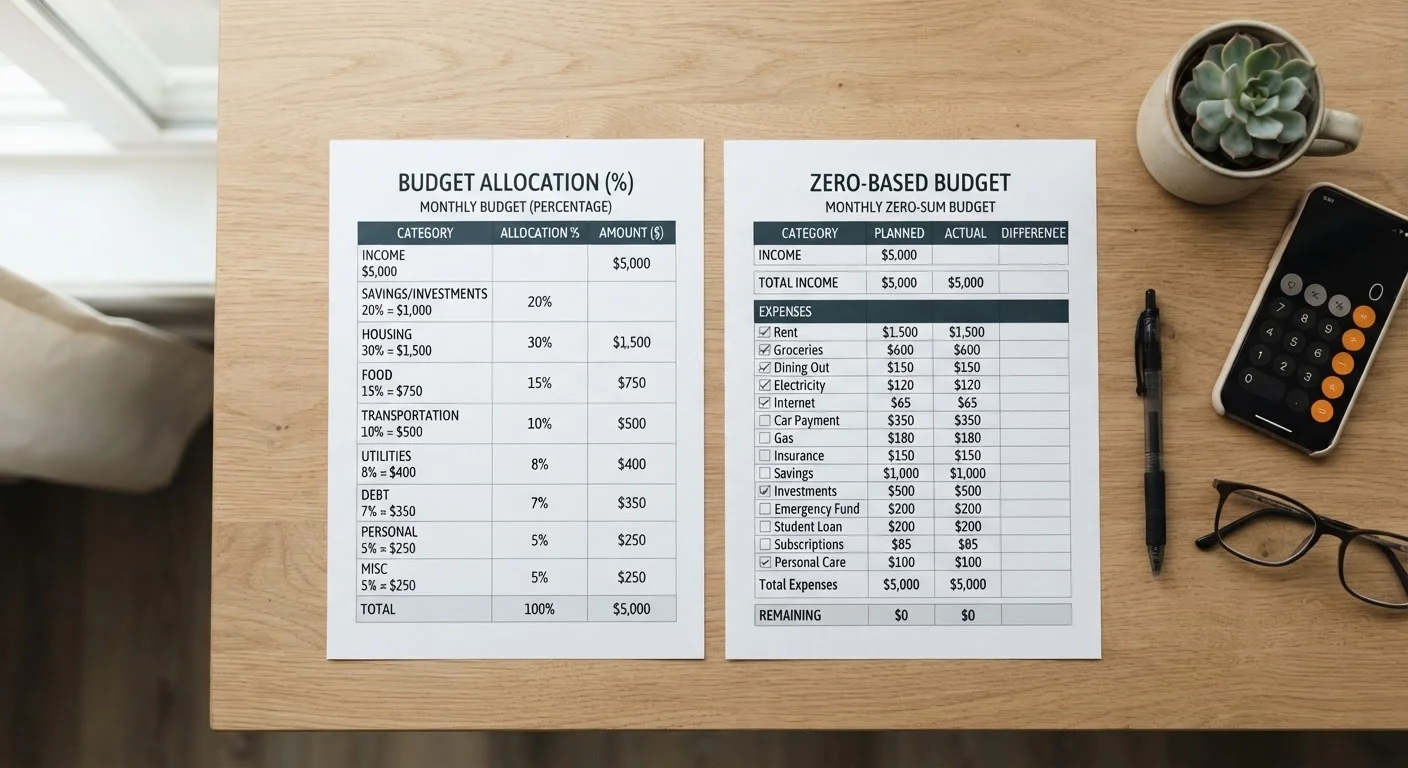
The solution is not to abandon budgeting - it is to adapt your approach to match the reality of how money actually flows into your life. The principles below are designed specifically for that reality. For a deeper look at how established frameworks compare, see Zero-Based Budgeting vs. the 50/30/20 Rule - both methods can be adapted for variable income with the right adjustments.
Core Practices for Budgeting Without a Fixed Paycheck
These practices form the foundation of a variable-income budget. Work through them in order the first time; after that, revisit them as part of a monthly reset.
Set your budget baseline using your lowest realistic monthly income
Planning around your average or best month means your budget will fail in any month below that figure. Using a conservative baseline - typically your lowest income month from the past six to twelve months - ensures your essential expenses are always covered, regardless of how the current month performs.
Calculate your 'survival number' by listing only non-negotiable fixed expenses
Knowing the minimum you need each month to keep housing, utilities, food, and debt payments current gives you a clear floor. This number tells you when a slow month is manageable versus when you need to draw on reserves, and it separates essential spending from discretionary choices you can adjust.
Open a dedicated income buffer account and pay yourself a consistent monthly amount
Depositing all client payments into a separate account and transferring a fixed 'salary' to your main spending account mimics how a paycheck works. This smooths out income spikes and shortfalls, so your day-to-day budget behaves as if income were predictable - even when it is not.
Assign every high-income surplus a job before you spend it
Irregular earners often spend more in high-income months and then struggle in slow months. Deciding in advance - during the good months - exactly how surplus funds will be split between savings, taxes, and discretionary spending prevents lifestyle creep and builds resilience.
Keep three to six months of survival expenses in a liquid emergency fund
For variable earners, an emergency fund is not just for unexpected events - it also covers predictable income gaps during slow seasons or client dry spells. A fund sized to your survival number, held in an FDIC-insured savings account, gives you time to find new work without taking on debt.
For a practical tool comparison to support whichever method you choose, see Spreadsheet Budgeting vs. App-Based Budgeting - both can handle variable-income tracking with the right setup.
Quick Actions You Can Take This Week
Getting started does not require a perfect system. These immediate steps build momentum and give you real data to work with.
Building savings habits alongside a budget is equally important. Our guide on building a savings plan around an irregular income walks through how to save consistently even when monthly pay varies.
Keeping Your Budget on Track Month After Month
36%
U.S. workers with some freelance income
According to Upwork's Freelance Forward research, roughly one in three U.S. workers performs freelance work alongside or instead of traditional employment.
~$400
Gap many adults can't cover from savings
Federal Reserve surveys have consistently found that a significant share of U.S. adults would struggle to cover a $400 unexpected expense without borrowing, underscoring why a buffer fund matters most for variable earners.
A variable-income budget is not a document you set once - it is a living practice. At the start of each month, review your previous month's actual income, compare it to what you planned, and adjust your spending categories accordingly. If you earned more than your baseline, decide in advance how that surplus is allocated: savings, debt payoff, or discretionary spending. Making that decision proactively prevents surplus income from disappearing without purpose.
For a structured approach to this process, our Monthly Budget Reset checklist provides a step-by-step review you can complete before each month begins.
Your budgeting needs will also shift as your career and life change. Budgeting across different life stages explores how to adapt your approach as income and priorities evolve over time.
This article is for general informational and educational purposes only. It does not constitute personalised financial advice. For guidance tailored to your individual circumstances, consider consulting a qualified financial professional.