How Each Framework Actually Works
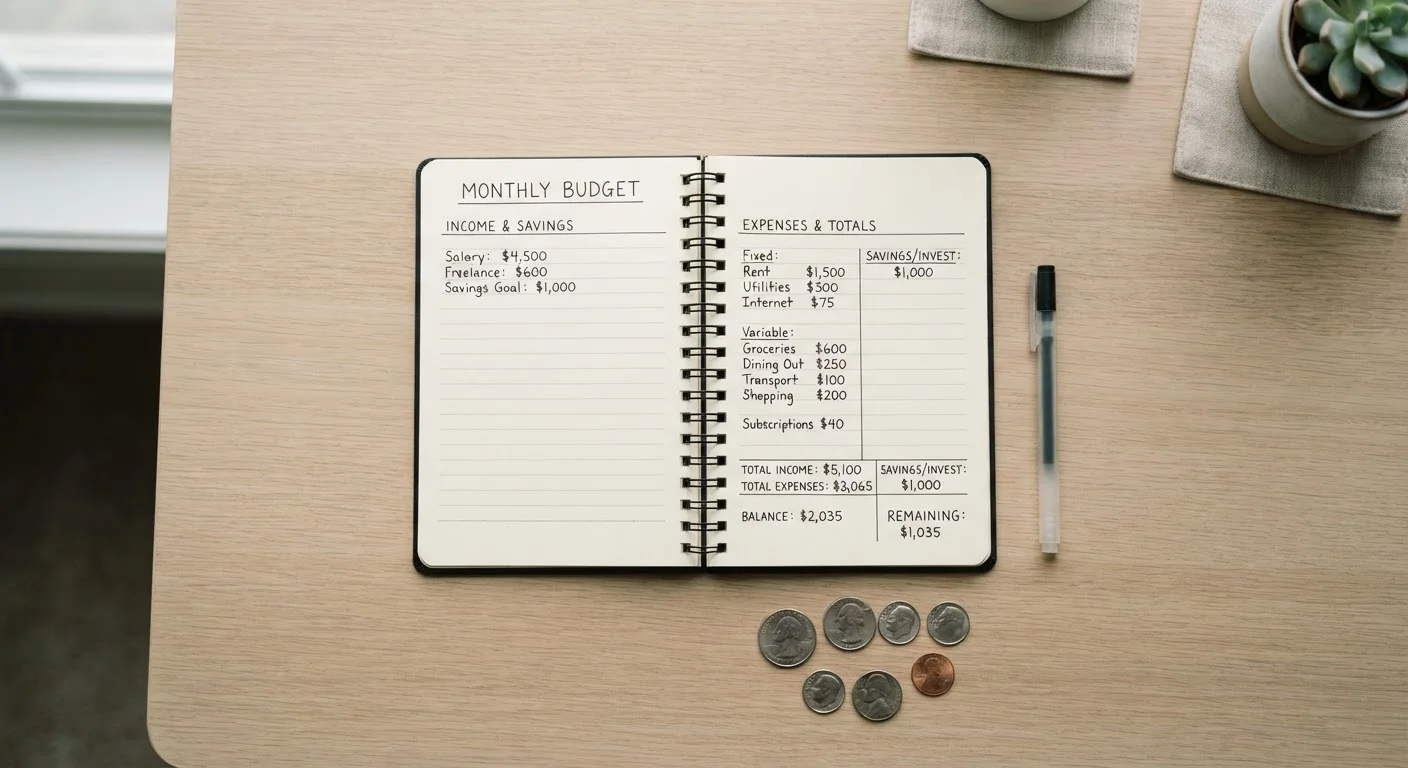
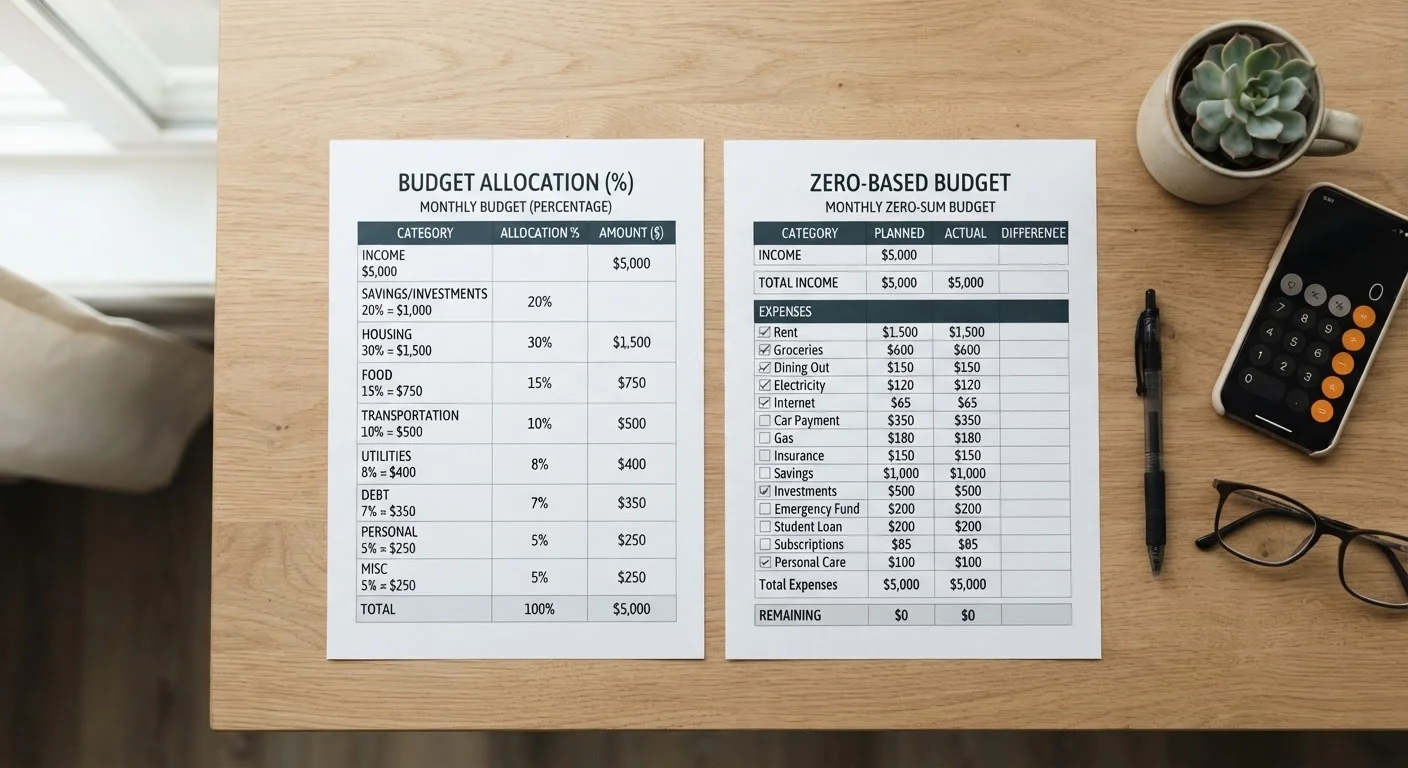
Zero-based budgeting (ZBB) starts with your total monthly income and works downward until every dollar is assigned to a category - expenses, savings, or debt - so that income minus outgo equals zero. Nothing is left unplanned. Each month essentially starts fresh, meaning you justify allocations based on this month's actual income rather than copying last month's figures automatically.
The 50/30/20 rule takes a top-down, percentage approach. After-tax income is split three ways: roughly 50% toward needs (rent, utilities, groceries), 30% toward wants (dining out, subscriptions, hobbies), and 20% toward savings and debt repayment. The percentages are guidelines, not rigid laws - some people adjust the split to 60/20/20 or 50/20/30 depending on their cost of living.
Understanding fixed vs. variable expenses is foundational to applying either method effectively. Fixed costs like rent are easy to slot in; variable costs like groceries require more careful estimation, especially under ZBB.
| Criterion | Zero-Based Budgeting | 50/30/20 Rule |
|---|---|---|
| Core concept | Every dollar assigned; income minus expenses = zero | Income split into three percentage categories |
| Monthly setup time | 30-60 minutes per month | Minimal after initial setup |
| Best income type | Variable or irregular income | Steady, predictable salary |
| Spending visibility | High - every category tracked | Moderate - broad buckets only |
| Flexibility mid-month | Requires manual reallocation | Easy to adjust spending naturally |
| Learning curve | Steeper - needs consistent tracking | Gentle - simple math to apply |
| Debt payoff focus | Strong - surplus directed intentionally | Moderate - relies on the 20% slice |
Time Investment and Ongoing Effort
Zero-based budgeting is the more time-intensive method. Setting up a new budget each month - accounting for any income shifts, one-time expenses, or irregular bills - can take 30 to 60 minutes. Many people use a spreadsheet or a dedicated budgeting app to track spending in real time against each category. If a category runs short mid-month, you manually reallocate from elsewhere.
The 50/30/20 rule, by contrast, is largely set-and-monitor. Once you know what percentage of your income each bucket represents, you check in periodically to confirm you haven't strayed too far. It doesn't require line-item accounting, which makes it sustainable for people who find detailed tracking tedious.
~33%
Americans with a detailed written budget
Gallup polling has consistently found that fewer than one-third of U.S. adults maintain a detailed household budget, highlighting how much room exists to improve financial planning habits.
60+ min
Average monthly time saved with simple budget frameworks
Financial planning researchers have noted that simplified percentage-based frameworks significantly reduce the administrative burden compared to line-item budgeting approaches.
If rigidity feels unappealing, our deeper look at the case for and against a strict monthly budget walks through the genuine advantages and real drawbacks worth weighing before you commit.
Which Works Better for Variable Incomes?
Variable income - common among freelancers, gig workers, and part-time employees - is where the 50/30/20 rule struggles most. If your paycheck changes every month, applying fixed percentages to an uncertain base is unreliable. A strong month might leave your 30% wants bucket artificially inflated; a weak month might mean your 50% needs bucket doesn't cover actual bills.
Zero-based budgeting adapts more naturally here. You start each month with whatever income you actually received (or a conservative estimate of what you expect), then assign dollars from there. This is consistent with the core principles outlined in our guide to budgeting on an irregular income, which focuses on planning around uncertainty rather than fighting it.
Salaried workers, on the other hand, often find the 50/30/20 rule perfectly adequate. With a predictable monthly net income, the percentage math is simple and repeatable. For a broader look at how budgeting needs evolve, see budgeting across different life stages.
Making Your Choice - and Sticking With It
Neither framework is universally superior. The right choice depends on your income consistency, your tolerance for detail, and the financial goals you're working toward right now. If you're actively building savings or paying down debt, both methods can support those goals - ZBB by forcing intentional allocation, and 50/30/20 by reserving a dedicated 20% slice for that purpose.
You don't have to pick one and never revisit it. Many people start with 50/30/20 to establish the habit of budgeting, then switch to zero-based budgeting once they want more precision. Others use ZBB during high-expense months and revert to simpler tracking when life is stable.
For a three-way comparison that also covers the envelope method, see the 50/30/20 rule, zero-based budgeting, and the envelope method compared. And if you're ready to build a full budgeting system from the ground up, our end-to-end personal budgeting guide walks through each step in plain language.
This article is for general informational and educational purposes only and does not constitute personalized financial advice. Consider consulting a qualified financial professional for guidance tailored to your specific situation.