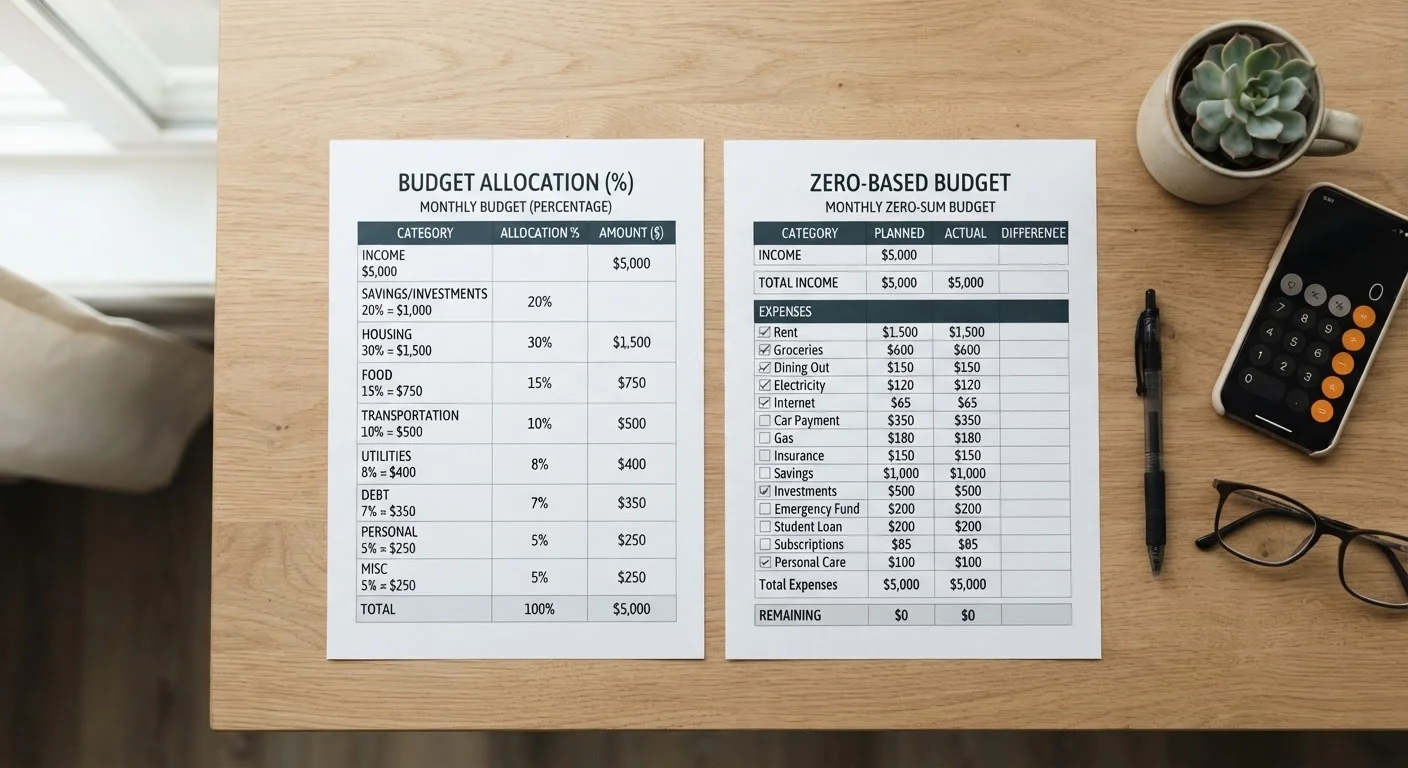

What 'Strict' Actually Means in a Monthly Budget
A strict monthly budget assigns a specific dollar amount to every spending category before the month begins - rent, groceries, transportation, entertainment, savings, and so on. Once a category is spent out, you stop spending in it. No rounding up, no borrowing from next month. This is the core discipline that separates a strict budget from a loose spending tracker.
Popular frameworks like zero-based budgeting make this literal: every dollar of income is assigned a job so that income minus expenses equals zero. If you want to compare how different frameworks approach this structure, see how zero-based, 50/30/20, and envelope methods compare.
Understanding what you're actually committing to helps you weigh the pros and cons honestly rather than abandoning the approach at the first friction point.
The Real Advantages of a Strict Budget
A tightly structured budget delivers concrete benefits that looser approaches often can't match - especially for beginners who are just learning to see where their money actually goes.
Eliminates financial guesswork from day one
When every category has a set limit, you always know whether you can afford something before you spend. This clarity reduces anxiety and impulsive decisions.
Accelerates progress toward savings goals
Treating savings as a fixed line item - rather than whatever's left over - ensures money actually reaches your emergency fund or other goals each month.
Exposes hidden spending patterns quickly
Assigning dollar amounts forces you to confront where money has been leaking. Many first-time budgeters are surprised to discover how much accumulates in categories like dining or subscriptions.
Builds consistent financial habits over time
Repeating the same planning and review process monthly creates a financial routine, making disciplined spending feel more automatic within a few months.
73%
Americans without a written monthly budget
According to Gallup polling, roughly three in four U.S. adults do not maintain a detailed household budget, highlighting how uncommonly this discipline is applied in practice.
~1 in 3
Adults who couldn't cover a $400 emergency
Federal Reserve surveys have consistently found that a significant share of U.S. adults would struggle to cover an unexpected $400 expense - underscoring why a structured savings allocation matters.
Beyond the numbers, a strict budget also builds a habit of intentionality. When you assign every dollar before you spend it, small purchases feel more deliberate, and lifestyle inflation - the gradual creep of spending as income rises - becomes easier to resist. For anyone working toward a concrete goal, a strict budget creates the accountability structure that saving and goal-setting strategies depend on.
The Real Drawbacks of a Strict Budget
Strict budgets fail people more often than people fail their budgets - and it's usually for predictable, avoidable reasons. Knowing these pitfalls in advance puts you in a better position to address them.
Difficult to maintain with irregular income
Fixed category limits assume a predictable paycheck. Freelancers or gig workers often find strict budgets collapse when income fluctuates significantly month to month.
One unexpected expense can derail the entire plan
A car repair, medical bill, or sudden travel need can blow through a category budget, leaving people feeling like they've failed and abandoning the system entirely.
Can feel punishing rather than empowering
If a budget leaves no room for enjoyment, it creates resentment. Research on behavior change consistently shows that overly restrictive systems are harder to maintain than moderate ones.
Time-consuming to set up and track consistently
A strict budget requires logging expenses regularly - sometimes daily. For busy people, this maintenance burden is often the first thing that gets skipped under pressure.
For those with irregular income - freelancers, gig workers, or anyone with commission-based pay - a fixed monthly allocation can feel arbitrary. A variable-income approach, which you can explore in this comparison of zero-based budgeting and the 50/30/20 rule, may offer a better fit.
How to Make a Strict Budget More Sustainable
The most effective budgets combine structure with just enough flexibility to survive real life. A few practical adjustments can prevent the all-or-nothing thinking that causes most budgets to collapse.
- Build a miscellaneous buffer. Reserve 3-5% of your monthly income as an unassigned buffer for irregular expenses you genuinely didn't predict.
- Do a monthly reset. Treat each month as a fresh start rather than a running tally of failures. A structured reset process helps - use this monthly budget reset checklist to review, adjust, and re-plan before the month begins.
- Choose your tracking method deliberately. A strict budget requires consistent logging. Whether you prefer a spreadsheet or a dedicated app affects how long you'll stick with it - compare the trade-offs of spreadsheet vs. app-based budgeting before committing.
Strict vs. Flexible: It's a Spectrum
A strict budget and a flexible budget aren't mutually exclusive - they sit at opposite ends of a spectrum. Many people start with a strict framework to understand their baseline spending, then loosen specific categories as their habits stabilize. The goal isn't rigidity for its own sake; it's awareness that leads to control. Revisiting and adjusting your budget regularly is a sign of good financial practice, not failure.
This article is for general informational purposes only and does not constitute personalized financial advice. Consider consulting a qualified financial professional for guidance specific to your situation.