Why Career Vocabulary Matters
Walk into any career planning conversation - with a mentor, a manager, or a coach - and you'll encounter a stream of jargon: OKRs, KPIs, stretch goals, horizon planning. If those terms feel unfamiliar, it's hard to engage confidently with the process they describe.
This reference guide translates the most commonly used career and goal-setting terms into plain English. You don't need to memorize everything at once. Think of this as a lookup resource: return to it whenever a term stops you in your tracks.
For a deeper look at how different planning systems compare, see our framework comparison guide. If you're still figuring out your direction entirely, Building a Career from Scratch is a strong starting point.
SMART Goals
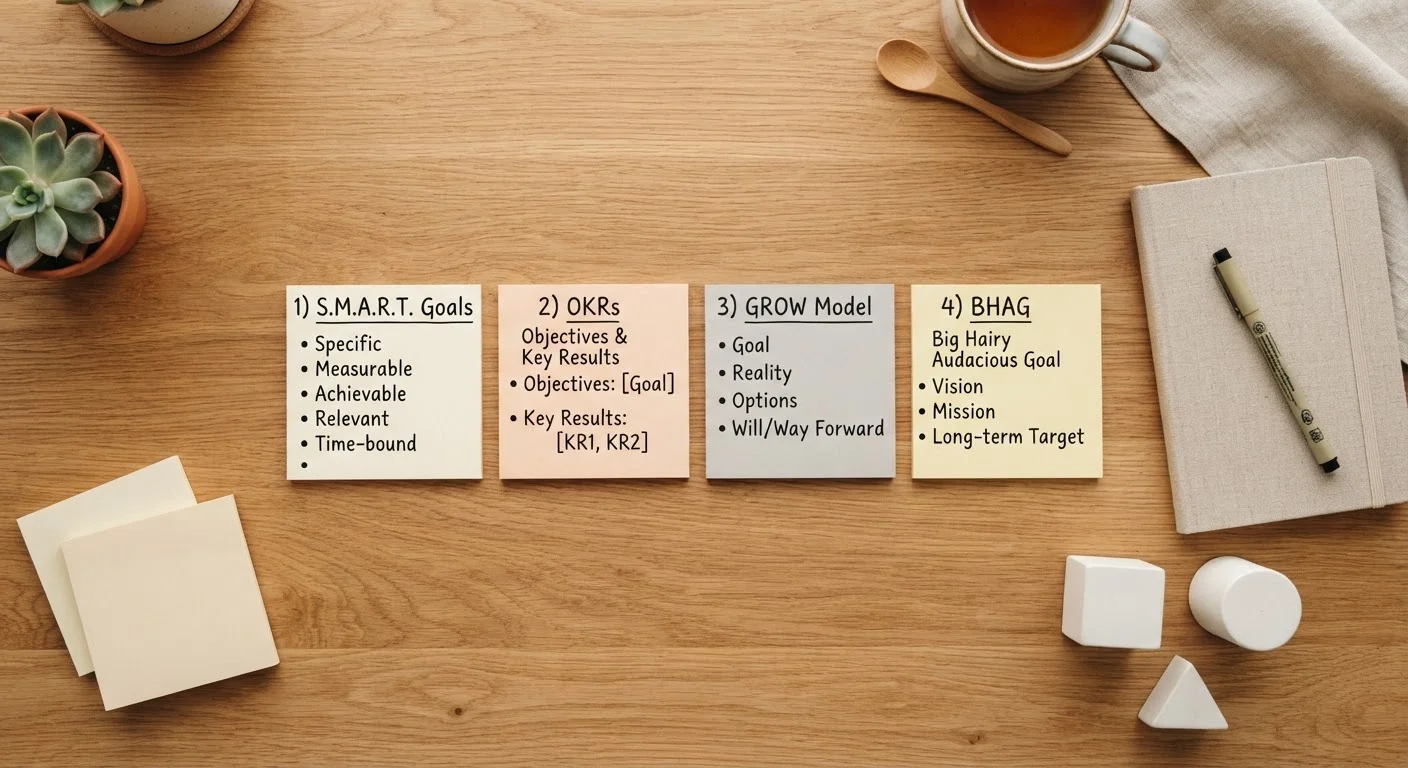
A goal-setting framework where each goal must be Specific, Measurable, Achievable, Relevant, and Time-bound. The acronym provides a checklist to test whether a goal is precise enough to act on.
OKRs (Objectives and Key Results)
A goal structure popularized in tech and business planning. An Objective is a qualitative, motivating destination; Key Results are two to five measurable outcomes that indicate you've reached it.
KPIs (Key Performance Indicators)
Quantitative metrics used to track progress toward a goal over time. Unlike OKRs, KPIs tend to be ongoing measurements rather than time-boxed targets - for example, monthly applications submitted or client satisfaction scores.
Stretch Goal
An ambitious target set deliberately beyond what feels comfortably achievable. Research in organizational psychology suggests stretch goals can increase motivation and innovation, but they work best alongside attainable baseline goals.
Horizon Planning
A planning approach that organizes goals across multiple time horizons - often short (weeks), medium (months), and long (years). It helps prevent the trap of only reacting to immediate demands while neglecting longer-range development.
Milestone
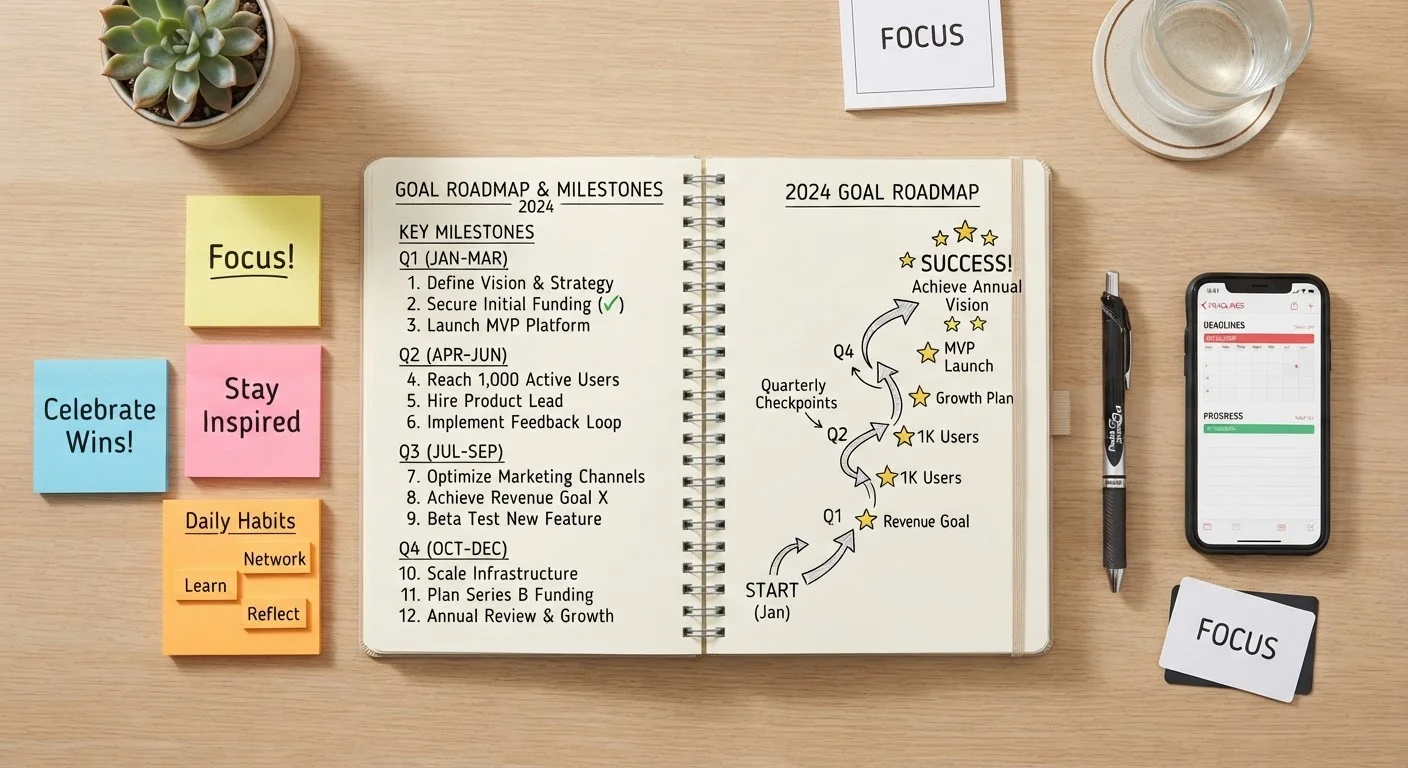
A specific, identifiable checkpoint along the path to a larger goal. Milestones break a multi-year ambition into smaller, verifiable moments of progress that can be celebrated and evaluated.
Career Pivot
A deliberate transition to a meaningfully different role, function, or industry - as opposed to a linear promotion within the same track. Pivots typically require identifying transferable skills and often involve a period of skill-building.
Transferable Skills
Competencies developed in one role or context that apply across different jobs or industries. Examples include project management, written communication, data analysis, and conflict resolution.
Professional Development Plan (PDP)
A documented roadmap outlining a person's career goals, the skills needed to reach them, and the specific actions and timelines for getting there. PDPs are commonly used in annual review cycles.
Accountability Partner
A peer or mentor who regularly checks in on your progress toward stated goals. Research on behavioral change suggests that social accountability meaningfully increases follow-through on commitments.
Lagging Indicator
A metric that reflects outcomes that have already occurred, such as a salary increase or a completed certification. Contrasted with leading indicators, which measure inputs or behaviors likely to drive future results.
Leading Indicator
A measurable activity or behavior that predicts future outcomes. In career planning, examples include weekly hours spent on skill practice or the number of networking conversations initiated per month.
Core Goal-Setting Concepts at a Glance
The terms below appear across industries and planning conversations. Understanding them helps you move from vague ambitions to concrete, trackable milestones.
| SMART acronym stands for | Specific, Measurable, Achievable, Relevant, Time-bound |
| OKR check-in frequency | Typically quarterly, with weekly team check-ins |
| Common planning horizons | Short (0-3 months), Medium (3-12 months), Long (1-5 years) |
| Purpose of a stretch goal | Push beyond comfort zone to encourage growth and innovation |
| Difference: KPI vs. OKR | KPIs track ongoing performance; OKRs target specific, time-boxed outcomes |
Specificity: The Difference Between Wishing and Planning
One of the most common pitfalls in career planning is setting goals that feel meaningful but lack enough precision to guide real decisions. A goal like "get better at communication" gives you nothing to act on. A goal like "facilitate one team meeting per month and request feedback from attendees" does.
Our article Why Vague Career Goals Stay Vague explores this in detail. For a structured way to add specificity, the SMART goals framework is a widely used starting point - though it has known limitations worth understanding before you rely on it exclusively.
When Goals Need Adjusting
Goals aren't permanent. Life circumstances shift - job markets change, personal priorities evolve, opportunities open or close. Revisiting a goal doesn't mean abandoning it; it often means refining it. When Ambition Outpaces Opportunity walks through how to recalibrate without losing momentum.
These Terms Aren't Universal Standards
Different organizations and industries use goal-setting terms in slightly different ways. A company might call its planning cycle "OKRs" but structure it more like traditional KPIs. When you encounter these terms in a new workplace, it's always worth asking how the organization specifically defines and uses them. What matters most is that the underlying practice - clear targets, measurable progress, defined timelines - is actually in place.
Connecting Career Goals to Financial Goals
Career goals and financial goals are closely linked - a promotion affects income, a pivot may require training costs, and freelance work brings variable earnings. As you build out your career plan, it helps to think in parallel about how your milestones connect to your broader financial picture.
Our Saving & Goals hub covers how to build savings habits and set realistic financial targets alongside your career planning work.
If you're interested in expanding your general learning vocabulary beyond career planning, The Beginner's Vocabulary of Learning Science offers a complementary glossary of terms like metacognition and interleaving that are directly relevant to skill-building.
Goal-Setting Frameworks Comparison
A side-by-side breakdown of SMART, OKRs, WOOP, and other frameworks to help you choose the approach best suited to your career stage and planning style.
Beginner's Vocabulary of Learning Science
A companion glossary covering terms like metacognition and interleaving - concepts directly relevant to anyone building new skills as part of their career plan.