Why Framework Choice Actually Matters
Most people approach goal-setting with genuine motivation but imprecise tools. Writing down "get a better job" or "save more money" provides direction but not traction. Goal-setting frameworks exist to convert vague intentions into structured plans with a higher chance of follow-through.
Research in motivation psychology consistently suggests that the process of goal formation - not just the goal itself - influences outcomes. Choosing a framework that fits your situation reduces decision fatigue and keeps you moving. For a deeper grounding in the vocabulary used across these systems, see the career goal-setting glossary before diving in.
The Four Frameworks at a Glance
Here is a structured look at how four widely used frameworks compare across key criteria.
| SMART | OKRs | WOOP | Hoshin Kanri | |
|---|---|---|---|---|
| Best time horizon | Days to months | Quarterly to annual | Days to weeks | One to five years |
| Core strength | Clarity and measurability | Ambition and accountability | Psychological realism | Strategic alignment |
| Learning curve | Low - beginner friendly | Moderate | Low to moderate | High |
| Solo or team use | Both | Both, especially teams | Primarily solo | Both, scales well |
| Handles uncertainty | Poorly - needs known path | Better - built for stretch | Well - plans for obstacles | Moderate - big picture focus |
| Review cadence | At deadline | Weekly or quarterly | Daily or as needed | Annual with quarterly check-ins |
Each framework is designed around a different assumption about what makes goals stick - clarity, ambition, psychological realism, or strategic alignment. Understanding those assumptions helps you choose wisely.
SMART Goals: The Accessible Foundation
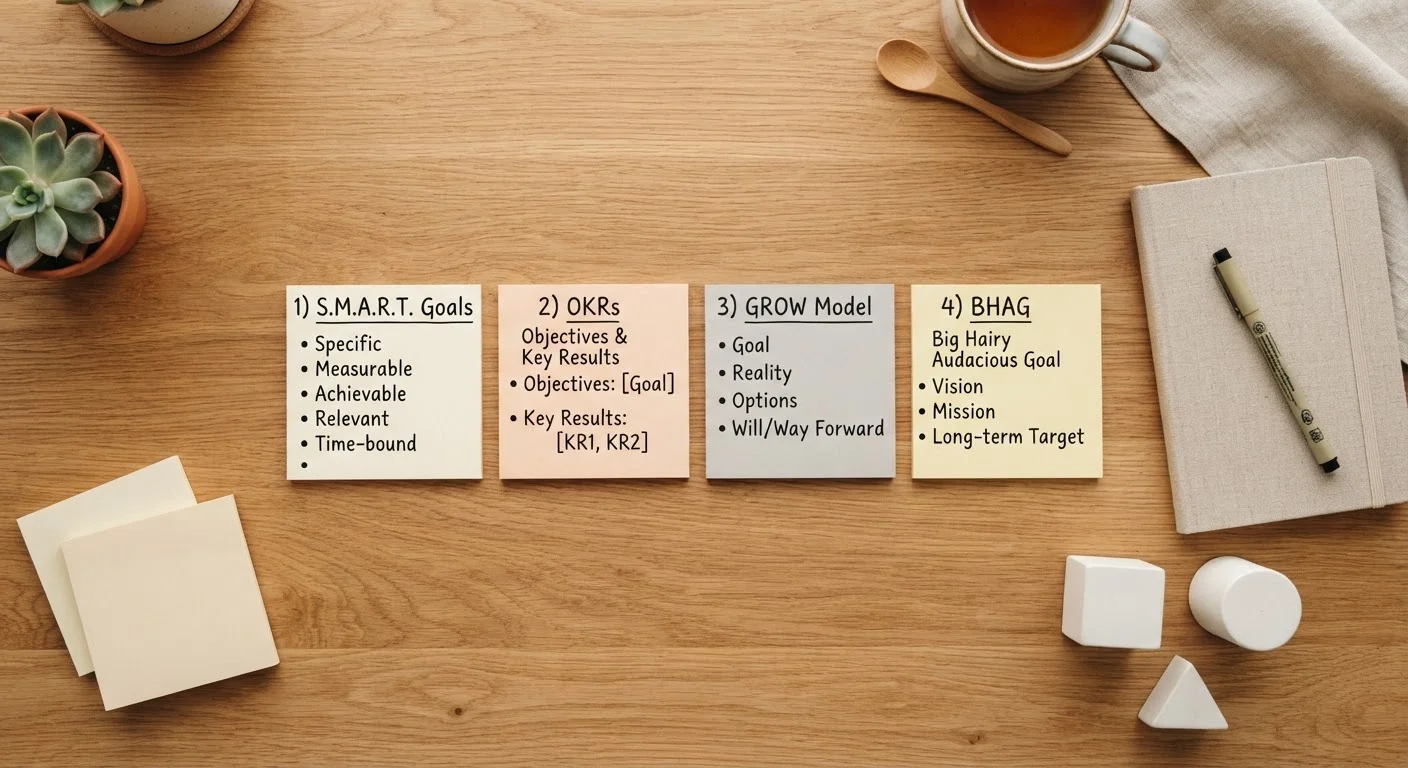
SMART stands for Specific, Measurable, Achievable, Relevant, and Time-bound. It is the most widely taught framework in schools, workplaces, and career-development programs - and for good reason. Its structure forces you to answer five essential questions about any goal before committing to it.
SMART works exceptionally well for short- to medium-term objectives where the path is relatively clear: completing a certification, reaching a project milestone, or building a portfolio. Its limitation is that it favors goals you can already define, which can make it too conservative for exploratory or transformational ambitions. For a detailed look at where this framework excels and where it breaks down, see SMART Goals Explained.
OKRs: Ambition With Accountability
OKRs (Objectives and Key Results) separate the what (an inspiring objective) from the how you'll know (two to five measurable key results). Developed in the tech industry and now widely adopted across sectors, OKRs are built for stretch - many practitioners aim to achieve roughly 70% of a key result, treating full achievement as a sign the goal wasn't ambitious enough.
For early-career professionals, OKRs are particularly useful for annual or quarterly career goals: "Become a credible public speaker" might pair with key results like delivering three presentations, receiving structured feedback from a mentor, and completing a communication workshop. OKRs also lend themselves to honest reflection because the cadence - typically quarterly reviews - is built into the system. Balancing this kind of long-horizon ambition with near-term momentum is explored in our article on short-term wins vs. long-term vision.
Set OKR Key Results You Can Actually Measure
When writing key results, avoid vague language like "improve" or "learn more." Instead, specify a concrete output: a number, a deliverable, or a behavior you can verify. If you cannot measure it at the end of the period, rewrite it until you can. This specificity is what separates OKRs that drive action from ones that collect dust.
WOOP: The Psychology-Backed Approach
WOOP - Wish, Outcome, Obstacle, Plan - was developed by psychologist Gabriele Oettingen based on her research into mental contrasting. Unlike frameworks that rely purely on positive visualization, WOOP explicitly asks you to identify the internal obstacles most likely to derail progress and then form an "if-then" plan to handle them.
Example: Wish - land a freelance client within three months. Outcome - stable supplemental income and proof of self-directed skills. Obstacle - tendency to procrastinate on outreach when anxious about rejection. Plan - if I feel reluctant to send a pitch, I will send one short message before opening any other app in the morning.
WOOP is particularly effective for behavior-change goals and situations where motivation has previously stalled. It is less suited to large organizational goals, where external coordination matters as much as inner psychology.
Hoshin Kanri: Long-Horizon Strategic Planning
Hoshin Kanri (roughly translated as "direction management") originated in Japanese manufacturing and has been adapted for personal strategic planning. It works by identifying a small number of breakthrough objectives - often just one or two - for a multi-year horizon, then cascading them down into annual goals, quarterly priorities, and monthly actions.
For most young adults, the practical takeaway from Hoshin Kanri is the discipline of the cascade: starting with a five-year vision, working backward to identify what must be true in three years, one year, and this quarter. This prevents the common trap of confusing busyness with progress. If your ambitions are shifting or outpacing current circumstances, the guide to adjusting goals without abandoning them offers complementary strategies for recalibrating gracefully.
Choosing and Combining Frameworks
No framework is mutually exclusive. Many practitioners combine elements: setting OKR-style objectives, then writing each key result using SMART criteria, and running a WOOP exercise for any goal that has historically stalled. Hoshin Kanri logic can provide the multi-year backbone within which quarterly OKRs nest naturally.
A practical starting approach for beginners: use SMART for any goal you need to achieve within the next 90 days, and OKRs for anything spanning six months or more. Add a WOOP session whenever you notice yourself procrastinating or doubting your follow-through.
Goal-setting frameworks share something important with budgeting frameworks - the best one is the one you'll actually use consistently. Just as with the comparison of budgeting methods, the sophistication of the system matters far less than your commitment to working it regularly.