What Each One Actually Is
Motivation and systems are often discussed as if they're competing forces. In practice, they serve very different functions in the behaviour-change process - and confusing the two is one of the most common reasons people struggle to follow through.
Instant motivation is an emotional state. It's the surge of energy you feel after watching an inspiring talk, setting a bold new goal, or hitting a personal low point that demands change. Motivation feels powerful because it is - in the moment. But like all emotional states, it rises and falls based on mood, stress, sleep, and circumstance.
Consistent systems, by contrast, are structured processes: the scheduled time, the environmental cue, the defined sequence of steps that run with or without enthusiasm behind them. A system doesn't care how you feel - it just waits for you to show up. To understand why this matters, it helps to explore the psychology behind why habits stick, particularly the role of cue-routine-reward cycles in making behaviour automatic.
| Criterion | Instant Motivation | Consistent Systems |
|---|---|---|
| Nature | Emotional, variable state | Structured, repeatable process |
| Reliability | Fluctuates with mood and stress | Operates independently of mood |
| Best stage | Starting and re-energising | Sustaining and scaling |
| Cognitive load | High - requires repeated decisions | Low - automates decision-making |
| Long-term effectiveness | Fades without structural support | Compounds with repetition over time |
| Risk | Burnout, stop-start cycles | Rigidity, loss of enthusiasm |
Why Motivation Alone Falls Short
Motivation is frequently cited as the missing ingredient when change stalls - but behavioural research suggests it's more of a catalyst than a fuel source. It works well for ignition; it's unreliable as an ongoing engine.
The core problem is motivational variability. Stress, fatigue, social pressure, and competing priorities all deplete the emotional reserves that motivation draws from. When those reserves are low, even genuinely desired goals get skipped. Over time, this creates a discouraging cycle: high ambition, strong start, gradual fade, and a sense of personal failure that makes the next attempt harder.
There's also a cognitive cost. Relying on motivation means repeatedly deciding whether to act - and each decision draws on finite mental energy. Self-discipline myths that make change harder than it needs to be explores how popular beliefs about willpower often misrepresent what the science actually supports.
66 days
Average time to form a new habit
A University College London study published in the European Journal of Social Psychology found habit formation took an average of 66 days, ranging widely by person and behaviour.
~40%
Daily behaviours that are habitual
Research published in Psychological Science estimated that roughly 40% of everyday actions are habits rather than conscious decisions.
How Systems Create Reliable Progress
A well-designed system offloads the work of decision-making onto your environment and schedule. Instead of asking "Do I feel like doing this today?", you ask "Is it the time and place I've set aside for this?" That's a much easier question to answer - and it's one that doesn't require motivation to resolve.
Effective systems share a few common elements: a consistent trigger (time of day, location, or prior action), a low entry barrier (starting small enough that resistance is minimal), and a defined sequence so the brain doesn't have to re-plan each time. These principles underpin frameworks like those compared in Atomic Habits vs Tiny Habits.
Systems also benefit from identity alignment - treating a behaviour not as something you do, but as an expression of who you are. Identity-based habits examines how this reframing changes both motivation and durability. When applied to fitness, for example, movement habits that stick shows how evidence-backed system design helps beginners stay active long past the initial excitement.
Using Both Together: A Practical Framework
The most effective approach doesn't choose between motivation and systems - it uses each at the right stage. Think of it as a two-phase model:
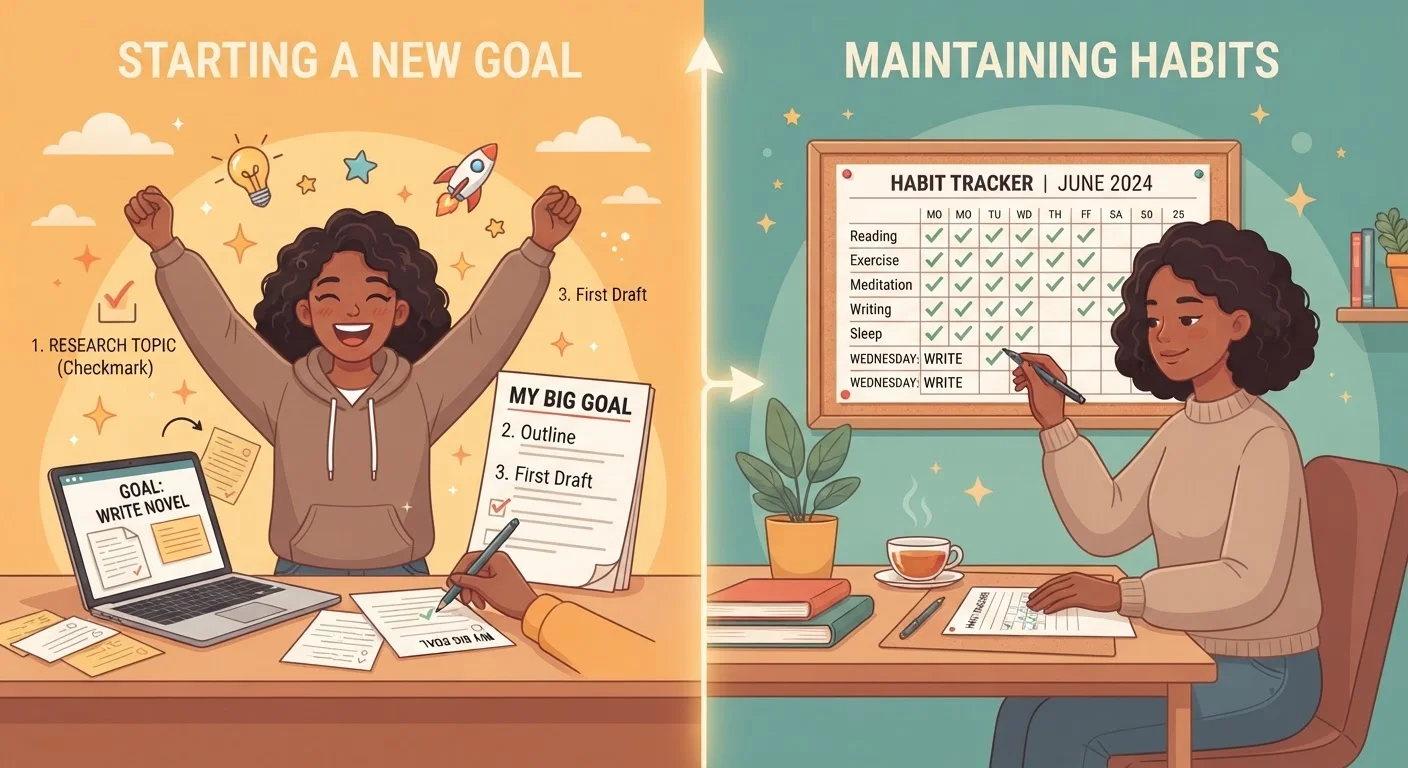
- Phase 1 - Ignition: Use motivation intentionally. Clarify your 'why', visualise the outcome, and let that emotional energy carry you into action. This is the time to set up your system - schedule it, design your environment, and define what the smallest possible version of the habit looks like.
- Phase 2 - Maintenance: Shift reliance to the system. Show up at the scheduled time. Follow the sequence. Resist the urge to skip when motivation dips - the system exists precisely for those days.
When the system starts to feel stale - when compliance is high but engagement is low - that's a healthy signal to reintroduce a motivational refresh: revisit your goals, raise the challenge slightly, or connect the behaviour to a renewed sense of purpose.
For a broader view of how these components fit together, the complete picture on habit formation and mindset change offers an end-to-end framework covering science, common pitfalls, and daily practices.
Motivation Can Be Deliberately Triggered
Motivation isn't something that only happens to you - it can be designed. Techniques like implementation intentions ('If X happens, I will do Y'), progress tracking, and connecting actions to meaningful values are evidence-supported ways to generate motivational momentum. The goal isn't to wait for inspiration but to create the conditions where it's more likely to arise - and then have a system ready to catch it.