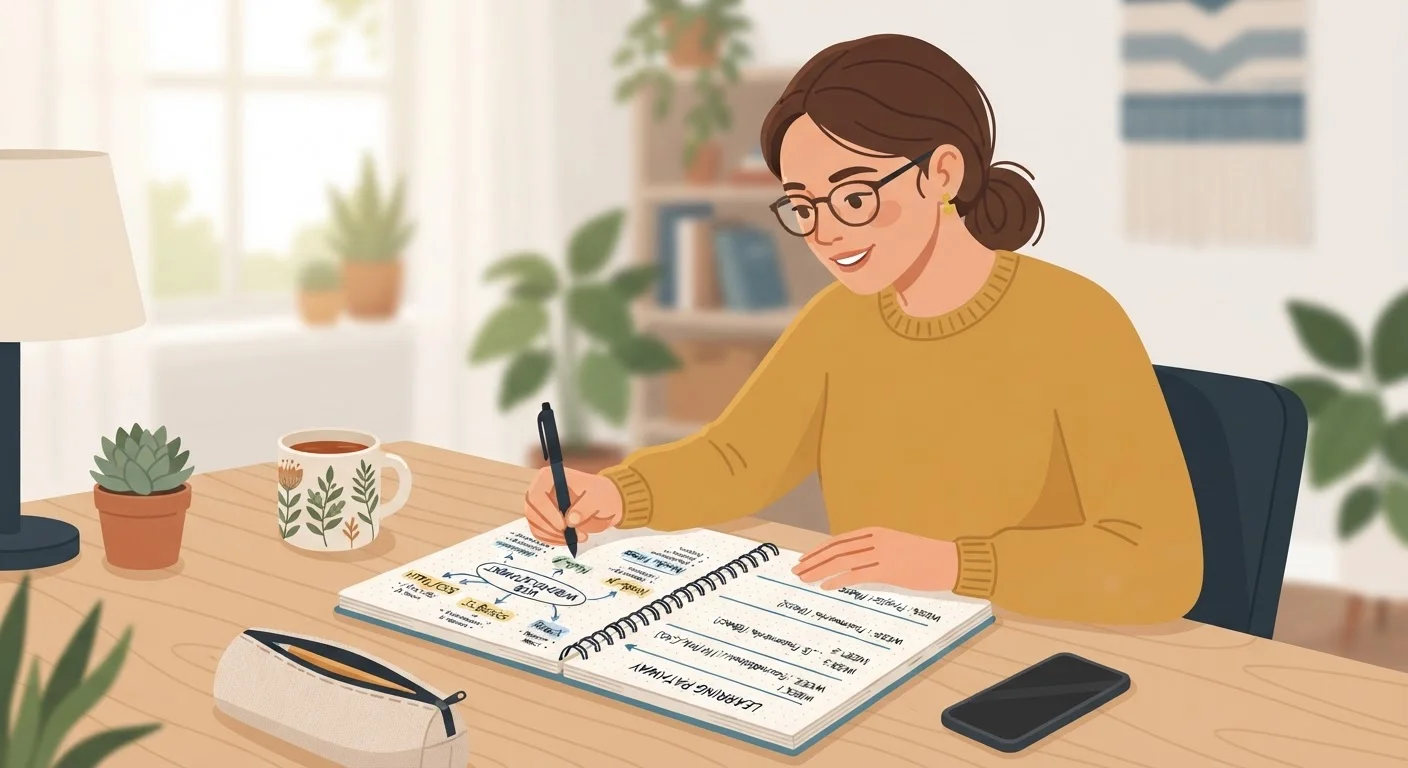

What Self-Directed Learning Actually Means
Self-directed learning (SDL) is the process of taking ownership of your own education - defining what to learn, how to learn it, and how to measure progress - without relying on a formal institution to design that path for you. Psychologist Malcolm Knowles, who popularized the concept, described it as a process in which individuals take initiative in diagnosing their own learning needs and evaluating their outcomes.
This approach is not the same as casual browsing or passive content consumption. True SDL involves deliberate planning, active practice, and honest self-assessment. It suits people who want to develop marketable skills, explore personal interests, or shift careers - without waiting for the right course or the right moment.
For a broader look at how SDL connects to building a career on your own terms, see our starter framework for ambitious beginners.
74%
Workers who plan to learn new skills
According to a Pew Research Center report, 74% of U.S. adults identify as personal learners who actively pursue new knowledge or skills on their own.
2x
Retention advantage of active recall over re-reading
Cognitive science research consistently shows that retrieval practice (self-testing) roughly doubles long-term retention compared to passive re-reading.
66 days
Average time to form a new habit
A study published in the European Journal of Social Psychology found that, on average, it takes 66 days for a new behavior to become automatic.
Step 1: Clarify What You Want to Learn and Why
Vague intentions like "learn coding" or "get better at writing" rarely survive contact with real life. Before gathering any resources, invest time in defining a concrete learning goal. A useful formula: skill + context + outcome. For example: "Learn Python well enough to automate data reports at work within three months."
Ask yourself two grounding questions: Why does this matter to me right now? and What will I be able to do differently when I've learned it? Answers to those questions will keep you anchored when motivation fades.
From there, break the large skill into sub-skills. Python, for instance, involves syntax basics, data structures, file handling, and libraries - each learnable in sequence. This decomposition prevents overwhelm and gives you early wins. Our guide on building a personal learning plan from scratch walks through this milestone-setting process in detail.
Write your learning goal as a commitment statement and put it somewhere visible - not just in a notes app. The physical act of seeing it daily reinforces intention during low-motivation periods.
Implementation intentions (specific if-then plans) have been shown in behavioral research to significantly increase follow-through compared to general goal statements.
Before you start any resource, skim its full outline or table of contents and identify the two or three sections most critical to your current goal. Prioritize those first rather than following a linear path by default.
This prevents the common trap of spending weeks on foundational content before reaching the skills you actually need, which drains motivation early.
Step 2: Choose Resources Strategically
One of the most common self-directed learning mistakes is resource hoarding - collecting dozens of courses, books, and tutorials without finishing any of them. Research on the "paradox of choice" suggests that more options often produce less action and lower satisfaction.
A practical rule: pick one primary resource per sub-skill, supplement only when you hit a genuine gap, and finish before moving on. Prioritize resources that include active exercises or projects over those that are purely lecture-based, since retrieval practice and application consistently outperform passive reading in learning science.
Consider the trade-offs between passion projects and structured curricula. Projects are highly motivating and context-rich; structured curricula offer logical sequencing that prevents knowledge gaps. The ideal approach often combines both - follow a structured path for fundamentals, then apply them in a project that matters to you. Our article on passion projects vs. structured curricula explores this balance in depth.
Step 3: Build Feedback Loops Into Your Practice
Without feedback, practice can reinforce bad habits as easily as good ones. Feedback loops are the mechanism that converts effort into genuine competence. There are three practical sources of feedback available to most self-directed learners:
- Self-assessment: After completing a practice problem or project, compare your output against worked examples, rubrics, or published work in the field. Note specific gaps, not just general impressions.
- Community review: Online communities - forums, Discord groups, open-source repositories - allow you to share work and receive critique. Even reading others' feedback on similar work teaches you to evaluate your own.
- Real-world application: The strongest feedback comes from using your skill in a genuine context: building something, publishing something, or contributing to a project where quality actually matters.
Without deliberate feedback, many learners plateau without realizing it. Understanding why that happens - and how to break through - is covered in our article on why self-taught learners plateau.
Step 4: Sustain Momentum Over Time
Motivation is unreliable. Habit and environment are far more durable. Research on habit formation consistently shows that attaching a new behavior to an existing routine - known as habit stacking - improves consistency. Decide not just what you'll practice but when, where, and for how long.
Set a minimum viable session length - even 20 minutes of focused daily practice compounds significantly over weeks. Track your sessions simply: a paper calendar, a habit-tracking app, or a plain notebook. Visibility reduces the likelihood of skipping.
Recognize that motivation dips are normal, not signs of failure. When energy drops, reduce scope rather than stopping entirely: instead of skipping a session, do five minutes. Keeping the streak alive matters more than any single session's output. For deeper strategies on mindset and habits that support long-term growth, explore our Mindset & Habits hub.
Beware the Consumption Trap
Watching tutorials and reading articles can feel productive, but passive consumption is not the same as learning. If your sessions are mostly watching or reading without producing something - code, writing, sketches, notes in your own words - you are likely accumulating information without building skill. Aim for a ratio where at least half of your study time involves active output or practice.
Putting It All Together
Self-directed learning is not about willpower or talent - it's about system design. When you clarify your goal, select resources deliberately, build honest feedback into your practice, and create environmental conditions that support consistency, learning becomes a reliable process rather than a hopeful experiment.
The learners who sustain progress over time are not necessarily the most disciplined. They are the ones who have designed a workflow that makes learning the path of least resistance. Start with one skill, apply this roadmap, and treat the first cycle as a pilot - then refine it.
Be aware that unstructured learning, while flexible, carries real hidden costs. Our contrasting guide on the hidden costs of learning without structure is worth reading before you begin, so you can design around those pitfalls from the start. And when you're ready to formalize your approach, see our Career & Goals hub for frameworks that connect your skill-building to real opportunities.