Why Start Minimal?
Walking into a bare kitchen for the first time can feel like standing in front of a blank exam paper. Every cooking show you've ever watched suggests you need a full batterie de cuisine - that's the French term for a complete set of kitchen equipment - before you can make anything worth eating. That's simply not true.
Starting minimal has a real advantage: it forces you to learn what you actually cook before you spend money on what you think you might cook someday. A half-dozen well-chosen items will serve you better than a crowded kitchen of duplicates and gadgets. This approach also pairs naturally with a broader strategy for setting up your first home without blowing your budget - see the room-by-room home setup guide for how the kitchen fits into the bigger picture.
Batterie de cuisine
A French culinary term for the complete collection of pots, pans, and tools in a kitchen. Used informally to mean a full kitchen equipment setup.
Non-stick coating
A surface applied to pans that prevents food from sticking during cooking. It requires low-to-medium heat and non-metal utensils to avoid damage.
Cast iron
A type of heavy, durable cookware made from molded iron. It retains heat well, can go from stovetop to oven, and lasts for decades with basic care.
Unitasker
A kitchen tool that does only one specific job - like an avocado slicer or an egg separator. These often take up more space than they're worth.
Stockpot
A large, deep pot used for making stocks, soups, boiling large amounts of pasta, or cooking big batches of food.
The Non-Negotiables: Your Day-One Kitchen List
These are the items that justify their cost immediately because you'll use them in almost every meal you prepare.
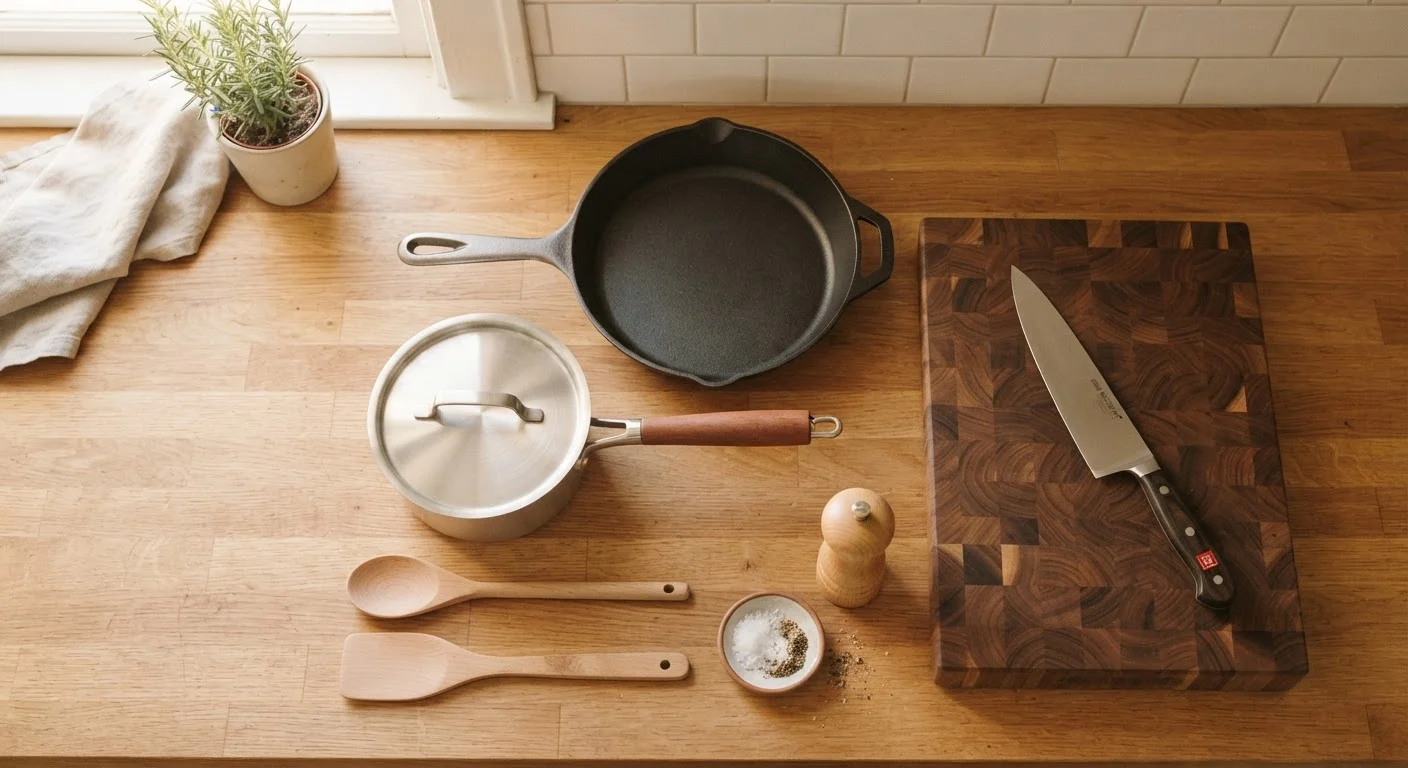
- Chef's knife (8-inch) - A single sharp, all-purpose knife handles chopping, slicing, and mincing far better than a block of dull, specialized blades.
- Cutting board - Plastic or wood, at least medium-sized. Don't cut directly on your countertop.
- Colander - For draining pasta, rinsing vegetables, and straining liquids.
- Spatula and wooden spoon - These two utensils cover most stirring, flipping, and scraping needs.
- Measuring cups and spoons - Essential until you develop an intuitive feel for quantities.
- Can opener - Manual versions are inexpensive and last for years.
- Mixing bowl - One large bowl works for salads, mixing batters, marinating, and more.
That's it for utensils. Keep the list honest - if you haven't cooked with something in the past year, you probably won't start now.
Cookware That Actually Earns Its Space
Cookware is where most beginners either overspend on sets or underspend on quality. The goal is a small number of versatile, durable pieces.
The short list
- 10-inch skillet - This is your most-used pan. Stainless steel handles high heat well and lasts a long time; a non-stick version is gentler for eggs and fish but requires more careful handling.
- 2- to 3-quart saucepan with lid - For boiling pasta, making sauces, heating soups, and cooking grains.
- Sheet pan (half-sheet size) - Roasting vegetables, baking, and reheating leftovers all happen here.
A large pot - sometimes called a stockpot or Dutch oven - is useful if you make soups, stews, or large batches of pasta regularly. But it's not a day-one necessity for most people.
Shopping secondhand? Prioritize cast iron
Cast iron pans are one of the best secondhand kitchen finds because their quality doesn't degrade the way non-stick does. A little rust on a thrift store cast iron pan can usually be cleaned and the pan re-seasoned - a straightforward process covered in many publicly available cooking resources. Inspect for cracks before buying, as those can't be repaired.
If budget is tight, cast iron skillets are worth knowing about: they're durable, versatile, and often available secondhand at low cost. They require a little more care (hand-wash and dry thoroughly), but many cooks use the same cast iron pan for decades.
What Can Wait
The following items appear in nearly every kitchen gadget list online. Most of them can safely wait until you've actually identified a need for them.
- Stand mixer - Useful if you bake regularly. Otherwise, a hand whisk or hand mixer does the job.
- Blender or food processor - Worth having eventually, but not before you know you'll make smoothies, soups, or sauces regularly.
- Rice cooker - A covered saucepan cooks rice just as well with a little practice.
- Specialty pans - Crepe pans, omelet pans, woks, and griddles each serve narrow purposes. Add them only when a general pan genuinely falls short for something you cook often.
- Knife sets - A chef's knife and a paring knife cover almost everything. A full block of eight knives is mostly redundant.
Scratched non-stick pans should be replaced
Once the coating on a non-stick pan is visibly scratched or peeling, it's time to stop using it. Replacing a worn non-stick pan is inexpensive and worthwhile. This is one of the few kitchen items where secondhand purchases carry a practical risk, so buy new or verify the surface is undamaged.
Being selective about your kitchen setup connects to a broader mindset around building your first home thoughtfully. The guide to furnishing your first flat applies the same logic to furniture and household items.
Building Your Kitchen Over Time
The best time to add a kitchen item is when you notice yourself working around its absence repeatedly. Cooked rice in a pot and it kept sticking? Maybe a rice cooker is worth it for you. Made soup three times and spent ten minutes mashing it by hand? A blender has earned its spot.
Thrift stores, resale apps, and estate sales are practical sources for things like cast iron pans, mixing bowls, baking dishes, and serving platters. Avoid buying used non-stick pans - scratched coatings are best replaced rather than reused.
As your cooking expands, so will your awareness of what different foods require. That growth pairs well with understanding what to put on your plate, not just how to cook it - the beginner's guide to everyday nutrition is a practical next read once your kitchen is functional.
Setting up a kitchen from zero doesn't require a big spend or a Pinterest-perfect setup. Start with what you'll use this week, then build forward from real experience.