What Each Lease Type Actually Means
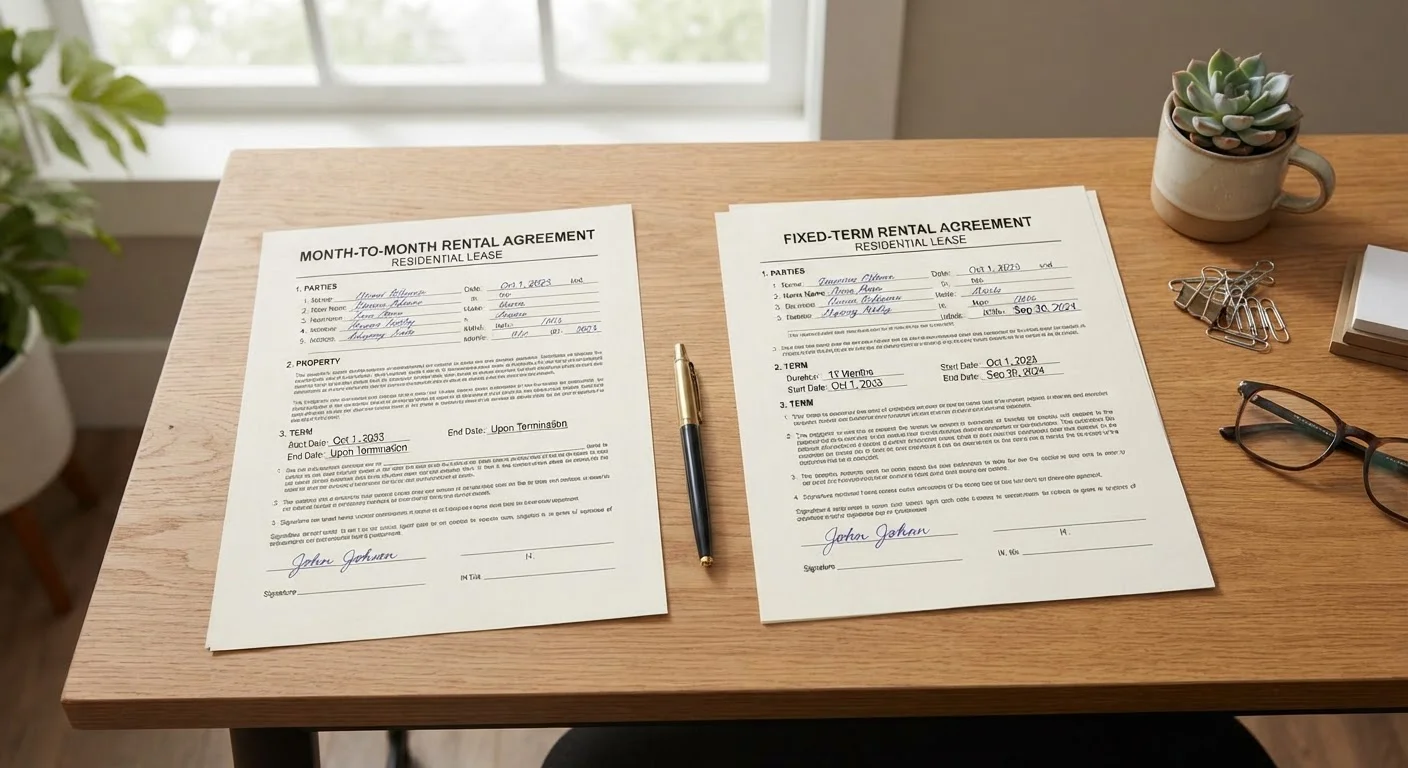
A fixed-term lease sets a defined rental period - most commonly 12 months - during which both you and your landlord agree to specific terms: rent amount, move-in and move-out dates, and rules for the property. Neither side can change those terms mid-lease without mutual written consent.
A month-to-month lease (sometimes called a periodic tenancy) renews automatically each month. Either party - you or your landlord - can end it with proper written notice, which is typically 30 days in most US states, though this varies. Some states require 60 days' notice depending on how long you've lived there.
Both are legally binding contracts. If you're unfamiliar with the terminology inside either type, our plain-English lease glossary breaks down the most confusing terms before you sign anything.
| Criterion | Month-to-Month | Fixed-Term (12 months) |
|---|---|---|
| Commitment length | Renews monthly; no set end date | Set period, typically 12 months |
| Monthly rent cost | Often higher (flexibility premium) | Usually lower; locked in for term |
| Rent increase risk | Possible with proper notice each month | Protected for the lease duration |
| Early exit penalty | Minimal - just notice required | Possible fees or continued liability |
| Landlord termination notice | Shorter notice (often 30 days) | Cannot end tenancy early without cause |
| Availability | Less common; landlord-dependent | Standard offering in most markets |
| Best for | Transitional or uncertain situations | Stable, settled living situations |
Flexibility vs. Security: The Central Trade-Off
Month-to-month agreements give you real exit flexibility - valuable if your employer might relocate you, if you're deciding between cities, or if you're between longer-term arrangements. That flexibility has a cost. Landlords often charge a premium of anywhere from $50 to several hundred dollars more per month compared to a comparable unit offered on a fixed-term basis, because they accept more uncertainty on their end.
Fixed-term leases give the landlord predictable income and give you predictable housing. Your rent cannot be raised during the lease term unless your contract explicitly allows it. That's meaningful protection in rental markets where prices shift quickly. The trade-off: leaving early typically triggers an early termination clause, which may require you to pay one to two months' rent as a penalty, or to keep paying until a replacement tenant is found.
30-60 days
Typical notice required to end a month-to-month tenancy
Notice requirements vary by state law; some states require longer notice periods for longer tenancies.
1-2 months
Common early termination fee range on fixed leases
Many fixed-term leases include an early termination clause requiring payment of one to two months' rent as a penalty.
12 months
Most common fixed-term lease length in the US
Annual leases are the standard offering across most US rental markets, according to general industry practice.
Before signing either type, read through the agreement carefully. Our guide on reading a lease without getting lost covers which clauses deserve the most scrutiny.
When Each Option Makes Sense
Month-to-month works well when:
- Your job situation is uncertain or you're in a probationary period with a new employer.
- You're new to a city and want to explore neighborhoods before committing.
- You expect a major life change - a move, a purchase, or a relationship shift - within the next year.
- You're bridging a gap between longer leases or waiting on a home purchase.
Fixed-term makes more sense when:
- You're confident in your city, neighborhood, and housing needs for at least 12 months.
- You want to avoid rent increases and know exactly what you'll pay each month.
- You're budgeting tightly and need the lower monthly cost a fixed-term usually offers.
- You want stronger protection against being asked to leave - landlords generally can't end a fixed-term lease early without legal cause.
Also keep in mind that landlords don't always offer both options. In competitive rental markets, most units are listed on fixed-term terms only. Month-to-month may be easier to find in slower markets or when a landlord already knows and trusts you as a tenant.
For a broader look at what renting actually costs versus alternatives, see our piece on renting vs. staying at home longer.
Common Mistakes to Avoid with Either Lease
No matter which type you sign, certain missteps catch first-time renters off guard. Assuming a verbal promise from a landlord - like agreeing to month-to-month terms informally - is one of the more costly errors. Get everything in writing. Our article on costly assumptions new renters make walks through where people most often get tripped up.
Also check the notice requirements carefully in your specific lease and state. Some renters give 30 days' notice only to discover their lease required 60. Others misread the auto-renewal clause and end up locked into another fixed term without realizing it. Read those sections twice.
Finally, consider the full picture of your housing costs - not just rent. Whether you're on a fixed-term or month-to-month arrangement, the decision interacts with other expenses. If you're comparing a furnished rental to an unfurnished one as part of this choice, our breakdown of furnished vs. unfurnished rentals is worth reading alongside this one.
This article is for general informational purposes only and does not constitute legal or financial advice. Lease laws vary by state and locality - consult a qualified professional or local tenant resource if you have questions about your specific situation.