
What a Budget Actually Is (and Isn't)
A budget is simply a written plan that tells your money where to go before the month begins. That's it. It is not a punishment, a vow of poverty, or a signal that you are bad with money. It is the same tool used by people across every income level to make intentional choices rather than reactive ones.
Think of it like a road map: you can still take detours, but you know your destination and how much fuel you have. Without one, it is easy to reach the end of the month wondering where everything went.
For a full grounding in the vocabulary you'll encounter along the way, see our budgeting glossary for beginners. And if you want the wider picture of personal finance beyond budgeting alone, our end-to-end personal budgeting guide covers everything from income to emergency funds.
Net income
The money you actually receive after taxes and deductions are taken out of your paycheck - the number your budget must be based on.
Fixed expense
A recurring cost that stays the same every month, such as rent or a car loan payment, making it straightforward to plan for.
Variable expense
A regular cost that changes in amount each month, like groceries or utility bills. You estimate these based on recent averages.
Irregular expense
A real but infrequent cost - such as an annual subscription or car registration - that catches many first-time budgeters off guard.
Zero-based budgeting
A method where every dollar of income is assigned to a category so that income minus all allocations equals zero, giving every dollar a purpose.
Discretionary spending
Money spent on wants rather than needs - things like entertainment, dining out, or hobbies - which is usually the most flexible part of a budget.
Step 1 - Calculate Your Real Take-Home Income
Your budget must be built on net income - the money that actually lands in your bank account after taxes, Social Security, Medicare, and any other payroll deductions. Using your gross (pre-tax) salary will make your budget look larger than it really is and lead to overspending.
Add up every reliable source of income for a typical month:
- Your primary paycheck (after deductions)
- Any consistent freelance or side income - use a conservative estimate if it varies
- Regular financial support, grants, or stipends
If your income is irregular, calculate an average across the last three to six months, then budget to the lower end of that range. This creates a built-in cushion.
Step 2 - List Every Expense You Can Think Of
Before categorizing anything, do a brain dump. Go through three months of bank and credit card statements and write down everything you spent money on. Most people are surprised by at least two or three categories they had completely forgotten.
Sort your expenses into three buckets:
- Fixed expenses
- The same amount, every month - rent, loan payments, subscriptions with a set fee. These are the easiest to plan for.
- Variable expenses
- Regular but fluctuating - groceries, utilities, gas, dining out. Average the last three months for a reliable estimate.
- Irregular expenses
- Infrequent but predictable - car registration, annual subscriptions, holiday gifts, dental visits. Divide the yearly total by 12 and set that amount aside monthly.
Missing irregular expenses is one of the most common first-budget mistakes. If you are also budgeting for housing costs for the first time, the renting basics hub can help you understand what to include beyond just your rent payment.
Use Bank Statements, Not Memory
When listing expenses, rely on actual statements rather than what you think you spend. Memory consistently underestimates spending, especially on small, frequent purchases. Most banks and credit card providers let you download three to twelve months of transaction history for free.
Step 3 - Choose a Budgeting Framework
A framework gives your categories structure so you are not just guessing at percentages. Here are three approaches suited to beginners:
The 50/30/20 Rule
Divide take-home income into: 50% for needs (rent, groceries, utilities, minimum debt payments), 30% for wants (dining out, entertainment, hobbies), and 20% for savings and extra debt repayment. The percentages are a starting point - adjust them to reflect your actual situation.
Zero-Based Budgeting
Every dollar of income is assigned to a category until the remaining balance equals zero. This does not mean spending everything - savings and investments are categories too. It simply means every dollar has a deliberate destination.
The Pay-Yourself-First Method
Move a set amount to savings the moment your paycheck arrives, then budget what remains for everything else. This makes saving automatic rather than an afterthought. Once you have your budget working month to month, the saving and goals hub can guide your next steps toward specific financial targets.
Step 4 - Assign Every Dollar a Job
Now combine your income total and your expense list with your chosen framework. In a spreadsheet or app, list every category and assign a dollar amount until your income minus all allocations equals zero (or your target savings amount is safely set aside).
A simple starting layout looks like this:
| Category | Type | Monthly Amount |
|---|---|---|
| Rent | Fixed / Need | $900 |
| Groceries | Variable / Need | $300 |
| Transportation | Variable / Need | $150 |
| Dining & Entertainment | Variable / Want | $200 |
| Emergency savings | Savings | $200 |
| Irregular expenses fund | Savings | $100 |
Your categories and amounts will look different - this is only a structural example. The goal is that every dollar has a label before the month begins. For context on how these priorities evolve, see how budgeting changes across life stages.
Step 5 - Track, Review, and Adjust
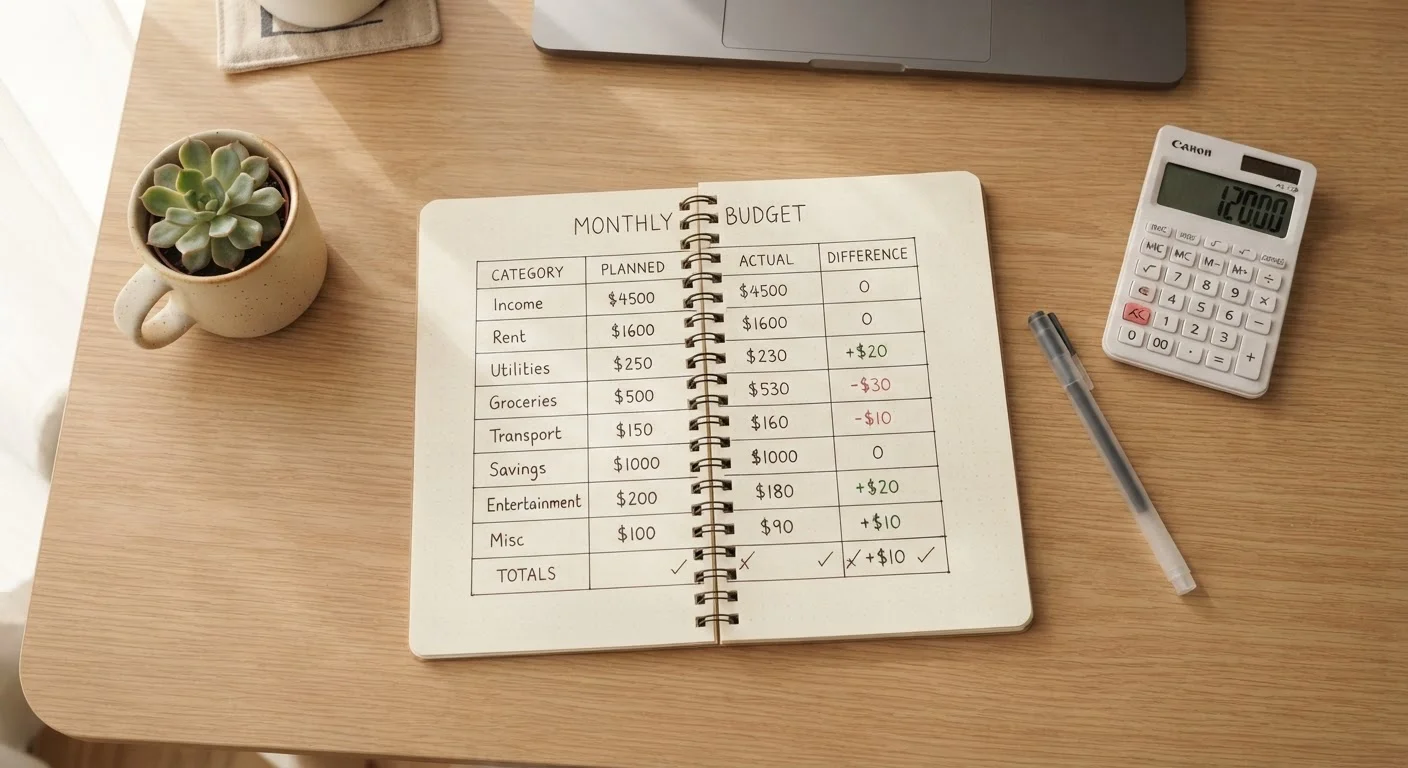
A budget written once and never looked at again is just a wish list. The real work - and the real benefit - comes from comparing what you planned to what you actually spent at the end of each month.
Set aside 15 to 20 minutes at the end of each month to ask:
- Which categories did I overspend in, and why?
- Which categories had money left over that I could redirect?
- Did any new irregular expenses appear that I need to plan for next time?
Your first budget will not be perfect, and that is expected. Each monthly review makes the next month's plan more accurate. To build a consistent review habit, the monthly budget reset checklist gives you a structured process to follow before each new month begins.
Budgeting is a skill, and like any skill, it improves with practice. Your first draft is simply the starting point.
Your Budget Will Change - That's Normal
Life circumstances shift: income rises, rent changes, new expenses appear. A budget is a living document, not a contract. Revisiting and revising it regularly is not a sign of failure - it is exactly how budgeting is supposed to work.
This article is for general informational and educational purposes only. It does not constitute personalized financial advice. Please consult a qualified financial professional for guidance specific to your individual circumstances.