
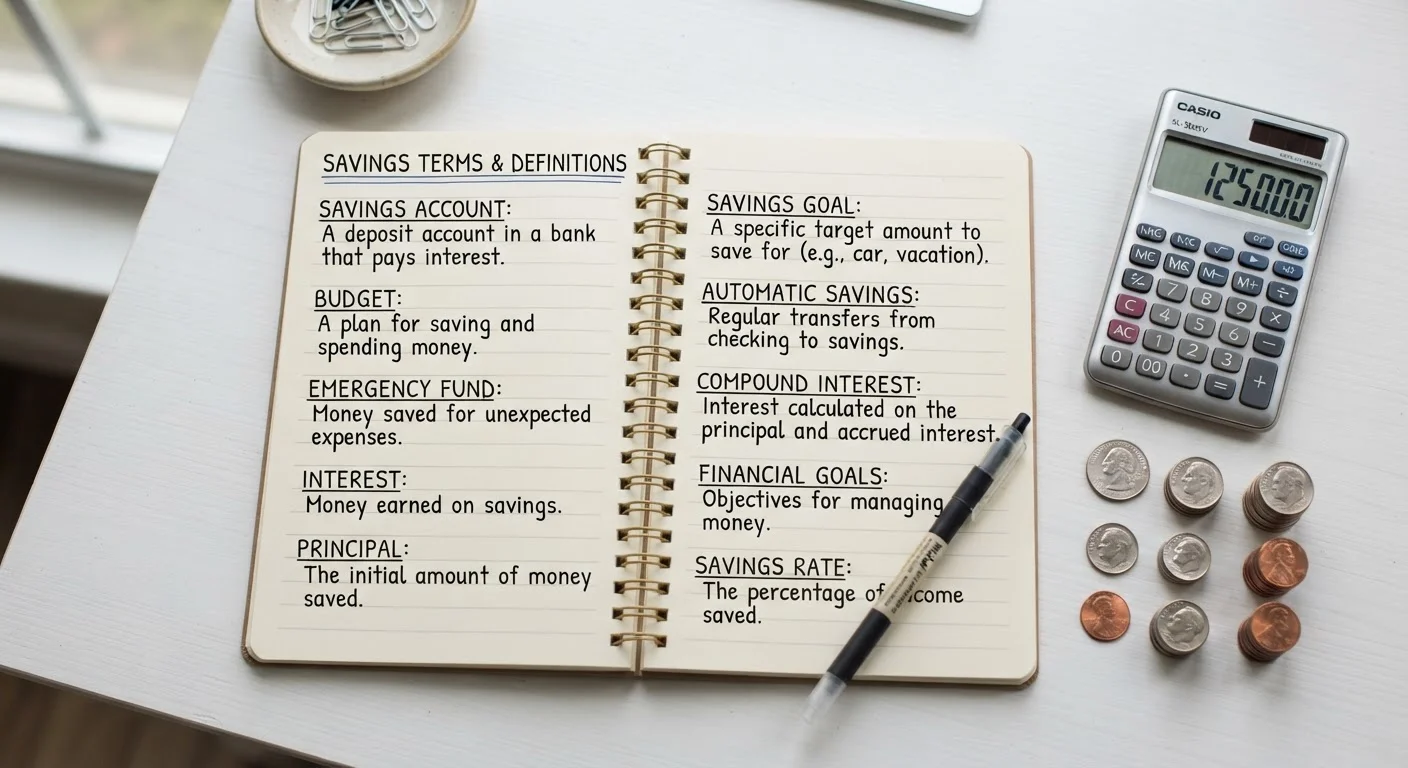
Why Savings Vocabulary Matters
Opening a savings account or reading a bank's product page often means running into a wall of terms - APY, liquidity, compounding frequency - that no one explains. When that happens, many people skip past the details and just accept whatever default they land on. That can cost real money over time.
This reference decodes the terms you're most likely to encounter when saving, whether you're opening your first account, comparing account types, or reading about savings strategies. Think of it as a vocabulary card you can return to whenever something doesn't make sense.
If you're still working on the fundamentals of building a habit, this complete guide for young adults walks you through the full process from opening your first account onward.
Annual Percentage Yield (APY)
The real rate of return you earn on a savings account over one year, factoring in how often interest compounds. APY is almost always higher than the stated interest rate and is the most accurate number to compare across accounts.
Compound Interest
Interest calculated on both your original deposit and the interest already earned. Over time, this creates a snowball effect where your balance grows faster the longer you leave money in the account.
Liquidity
How quickly and easily you can access your money without penalty or delay. A regular savings account has high liquidity; a certificate of deposit (CD) has lower liquidity because withdrawing early typically triggers a penalty.
High-Yield Savings Account (HYSA)
A savings account that offers a significantly higher APY than a standard savings account, often found at online banks. These accounts are typically FDIC-insured and keep your money accessible.
FDIC Insurance
Protection provided by the Federal Deposit Insurance Corporation that covers depositors' funds at insured US banks up to applicable limits per depositor, per institution, per ownership category, in the event of a bank failure.
Certificate of Deposit (CD)
A savings product where you deposit money for a fixed term (e.g., 6 months, 1 year, 5 years) at a fixed interest rate. You generally earn a higher rate than a savings account, but early withdrawal usually incurs a penalty.
Compounding Frequency
How often a bank calculates and adds interest to your balance - daily, monthly, or annually are common intervals. More frequent compounding means slightly faster growth, even at the same stated rate.
Emergency Fund
A dedicated pool of savings set aside to cover unexpected expenses or income loss. It is typically kept in a liquid, low-risk account rather than invested, so the money is available when needed.
Minimum Balance
The lowest account balance a bank requires you to maintain, often to avoid a monthly maintenance fee or to earn the advertised interest rate. Falling below this threshold may trigger charges.
Sinking Fund
A savings strategy where you set money aside over time specifically for a known future expense - a car repair, vacation, or annual insurance premium. It prevents large predictable costs from disrupting your budget.
Automatic Transfer
A scheduled, recurring movement of money from one account to another - typically from checking to savings - set up in advance. Automating this process removes the need to manually move money each pay period.
Interest Rate
The basic percentage a bank pays you on your deposited balance, before accounting for compounding. The interest rate is always equal to or lower than the APY for the same account.
Key Savings Terms at a Glance
Use the quick-reference card below for the numbers and facts that give these terms real-world context, then read the fuller definitions above whenever a concept needs more unpacking.
| FDIC insurance limit | $250,000 per depositor, per insured bank, per ownership category (Federal Deposit Insurance Corporation (FDIC)) |
| Typical savings account APY | Often well below 1% at traditional banks; higher at online banks (General industry range; verify current rates with your institution) |
| Common emergency fund target | 3-6 months of essential living expenses (General personal finance guidance; individual needs vary) |
| CD term range | Typically 1 month to 5 years (Varies by financial institution) |
| Compounding frequency options | Daily, monthly, quarterly, or annually - daily is most favorable (Standard industry practice) |
One term that trips up almost everyone is APY vs. interest rate. A bank may advertise an interest rate, but the APY is what you'll actually earn over a year, because it accounts for how often that interest compounds. Always compare APYs - not raw interest rates - when evaluating accounts.
Another common point of confusion: FDIC insurance. It protects your deposited money (up to applicable limits) at insured banks if the bank fails - it has nothing to do with investment returns or market performance. If you're also learning how credit and debt products work alongside saving, the Credit & Debt hub covers loans, credit scores, and debt management in the same plain-language style.
Understanding compounding is especially worthwhile because its effects grow over time. Learn how compound interest turns small deposits into something significant - the math is simpler than most people expect.
Putting the Terms to Work
Knowing these definitions is only useful if they help you make better decisions. Here's how the most important concepts connect in practice:
- Liquidity vs. yield trade-off: High-yield savings accounts offer better APYs than standard savings accounts but keep your money liquid. CDs typically offer higher rates still, but you give up liquidity for the term length. Choosing between them depends on when you'll need the money.
- Compounding frequency matters: An account that compounds daily will grow slightly faster than one that compounds monthly, even at the same stated rate. Over years, that difference adds up.
- Emergency fund sizing: Most personal finance guidance suggests three to six months of essential expenses - but the right amount depends on your income stability, expenses, and other financial safety nets. This is general guidance, not a guarantee of adequacy for your situation.
- Automatic transfers and minimum balances: Many accounts waive monthly fees if you maintain a minimum balance or set up automatic deposits. Understanding these triggers - the minimum balance and automatic transfer terms - can help you avoid fees that quietly erode savings.
If you're saving alongside a partner, approaches that reduce conflict and build progress together explores how to align on shared goals without friction. And once you understand the vocabulary, automating your savings becomes much easier to evaluate clearly.
This article is for general informational and educational purposes only. It is not personalized financial advice. For decisions specific to your financial situation, consider consulting a qualified financial professional.