The Basic Mechanic: Interest on Interest
Imagine you deposit $1,000 into a savings account earning 5% annual interest. After one year, you earn $50 in interest, bringing your balance to $1,050. In year two, that 5% is applied to $1,050 - not just your original $1,000 - so you earn $52.50. The following year, you earn interest on $1,102.50. Each cycle, the base grows a little bigger.
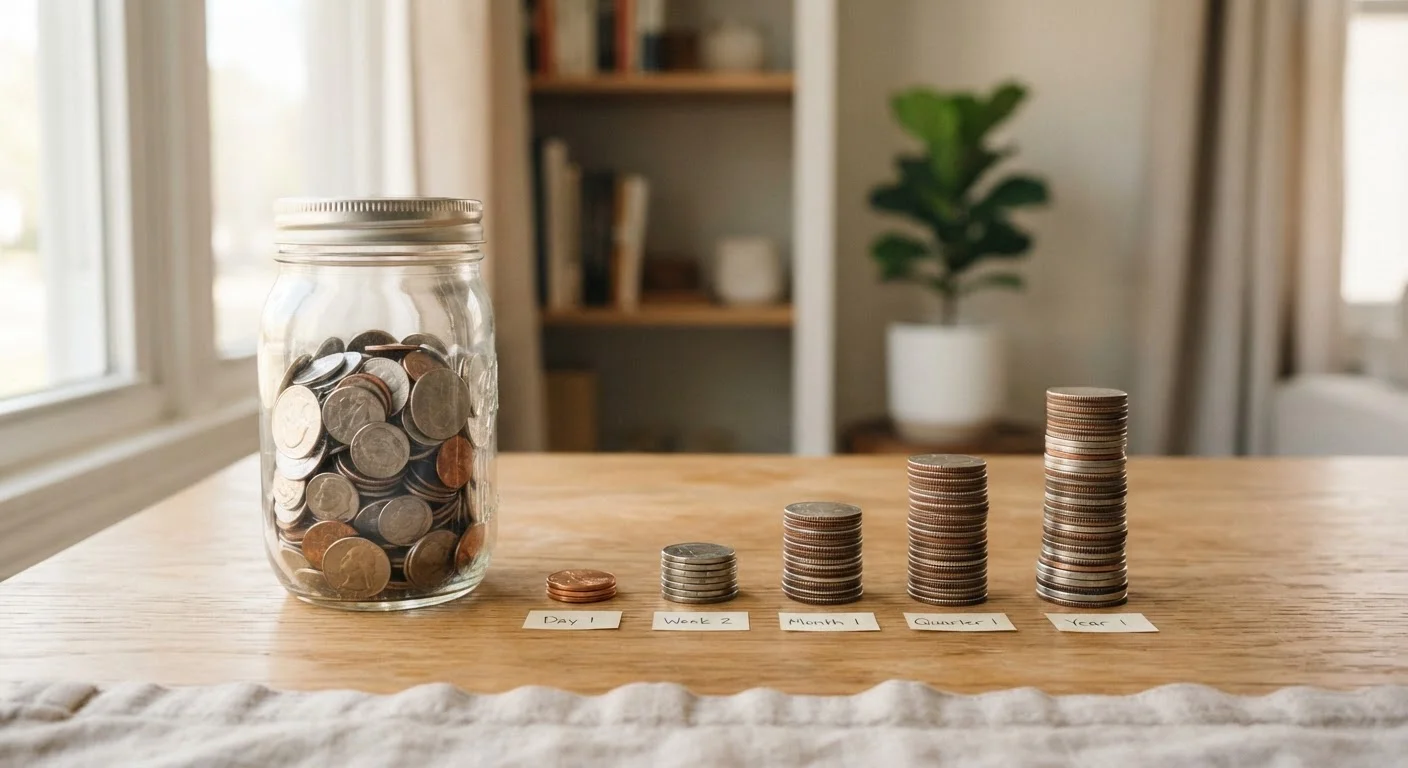
This self-reinforcing loop is what makes compounding qualitatively different from simple interest. The growth is not linear; it curves upward. In early years the difference looks trivial. Over a decade or more, it becomes pronounced.
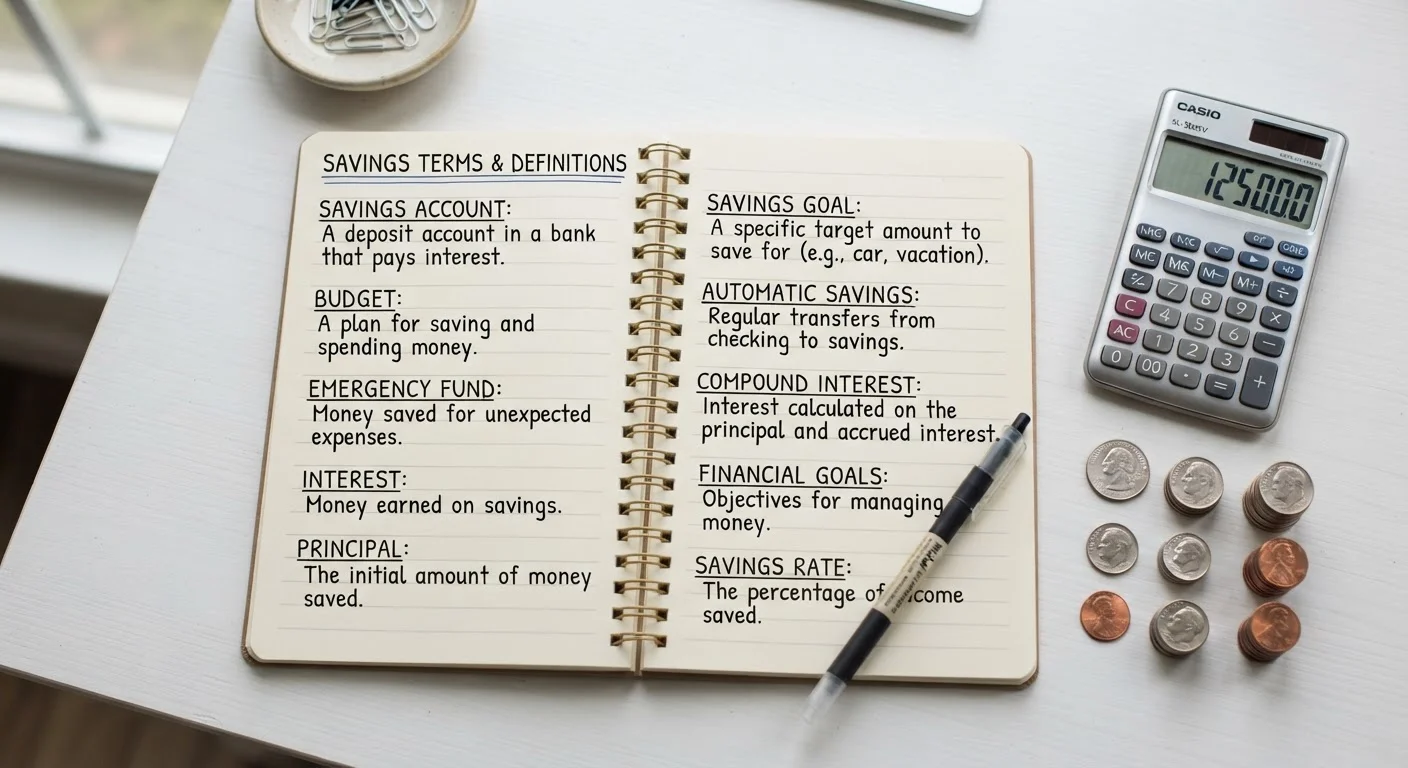
For a plain-language breakdown of the vocabulary that surrounds this topic, see our savings terms reference.
72
The Rule of 72 doubling estimate
Divide 72 by an annual interest rate to estimate roughly how many years it takes a balance to double - a widely used mental math shortcut in personal finance education.
Daily
Most common compounding frequency for savings accounts
Many FDIC-insured savings accounts compound interest daily, meaning earnings are added to the principal each day and begin generating their own interest immediately.
10 years
Potential extra compounding time from starting earlier
Beginning a savings habit a decade sooner can add one full doubling cycle at moderate interest rates, according to standard compounding illustrations used in financial literacy education.
Why Starting Earlier Has an Outsized Effect
Time is the variable that makes compounding genuinely powerful. The longer your money compounds, the more cycles of "interest on interest" accumulate. This is why personal finance educators consistently emphasize beginning a savings habit as early as possible - even with small amounts.
Consider two people: one begins saving at 22, the other at 32. Both contribute the same monthly amount for the same number of years until retirement. The person who started at 22 typically ends up with a significantly larger balance - not because they contributed more total dollars, but because their money had more compounding cycles to work through. Time essentially does work that larger deposits cannot easily replicate.
The Rule of 72 captures this intuitively: divide 72 by your annual interest rate to estimate how many years it takes your money to double. At 6%, a balance roughly doubles every 12 years. Starting 10 years earlier can mean one full additional doubling - a meaningful difference.
“Compound interest is the eighth wonder of the world. He who understands it, earns it; he who doesn't, pays it.”
— Attributed to Albert Einstein, Widely cited in personal finance and financial literacy education (attribution debated by historians)
How Regular Deposits Amplify the Effect
A single deposit benefits from compounding, but regular deposits turn compounding into a growth engine. Every new contribution you make immediately becomes part of the compounding base. Each dollar added today participates in every future compounding cycle - whether that cycle is months or decades away.
This is why pairing a consistent savings habit with a compound-interest account is a well-regarded personal finance strategy. The pay-yourself-first approach - setting aside a fixed amount before spending anything else - complements compounding directly: it ensures deposits happen predictably, rather than irregularly.
If you'd like to understand why a fixed monthly amount consistently outperforms saving whatever is left over, this article explains the habit in detail.
Automate Deposits to Stay Consistent
The most reliable way to ensure regular contributions is to make them automatic. Setting up a recurring transfer from your checking account on payday removes the decision entirely - your savings grow without requiring monthly willpower. Even a small automated amount benefits from every compounding cycle it participates in.
The Other Side: Compound Interest on Debt
Compound interest is a tool, not inherently an advantage. When it applies to debt - particularly credit card balances - it works against you with the same relentlessness. Unpaid interest is added to the principal you owe, and next month's interest is calculated on that larger total. Balances can grow quickly if only minimum payments are made.
Understanding this asymmetry is one of the most practical insights personal finance can offer: the same mechanic that patiently builds savings can just as patiently erode financial stability when it sits on the wrong side of your balance sheet. Paying down high-interest debt is often a high-priority financial move precisely because it stops that compounding from working against you.
This article is for general informational and educational purposes only and does not constitute personalized financial advice. Consult a licensed financial professional for guidance tailored to your specific circumstances.