
Why Saving Last Almost Never Works
Most people approach savings the same way: spend throughout the month, then save whatever remains. In theory, this is sensible. In practice, something always fills the gap. An unexpected dinner out, a sale, a subscription renewal - and suddenly there's nothing left to move to savings.
This isn't a character flaw. It's a predictable outcome of how spending works. When money is sitting in a checking account, it's available, and available money tends to get spent. Willpower alone is rarely a reliable defense against that reality.
Pay yourself first flips the sequence. By moving money to savings the moment your paycheck arrives, you redefine what "available" means. You spend from what remains, and your savings goal is already met - before you've made a single discretionary decision. See how this compares to the alternative in our article on why saving a fixed amount upfront beats saving what's left.
How the Mechanics Actually Work
The strategy has two components: the decision and the automation. The decision is choosing an amount - even a modest one - to save from each paycheck. The automation is what turns that decision into a consistent habit without requiring you to act on it each pay cycle.
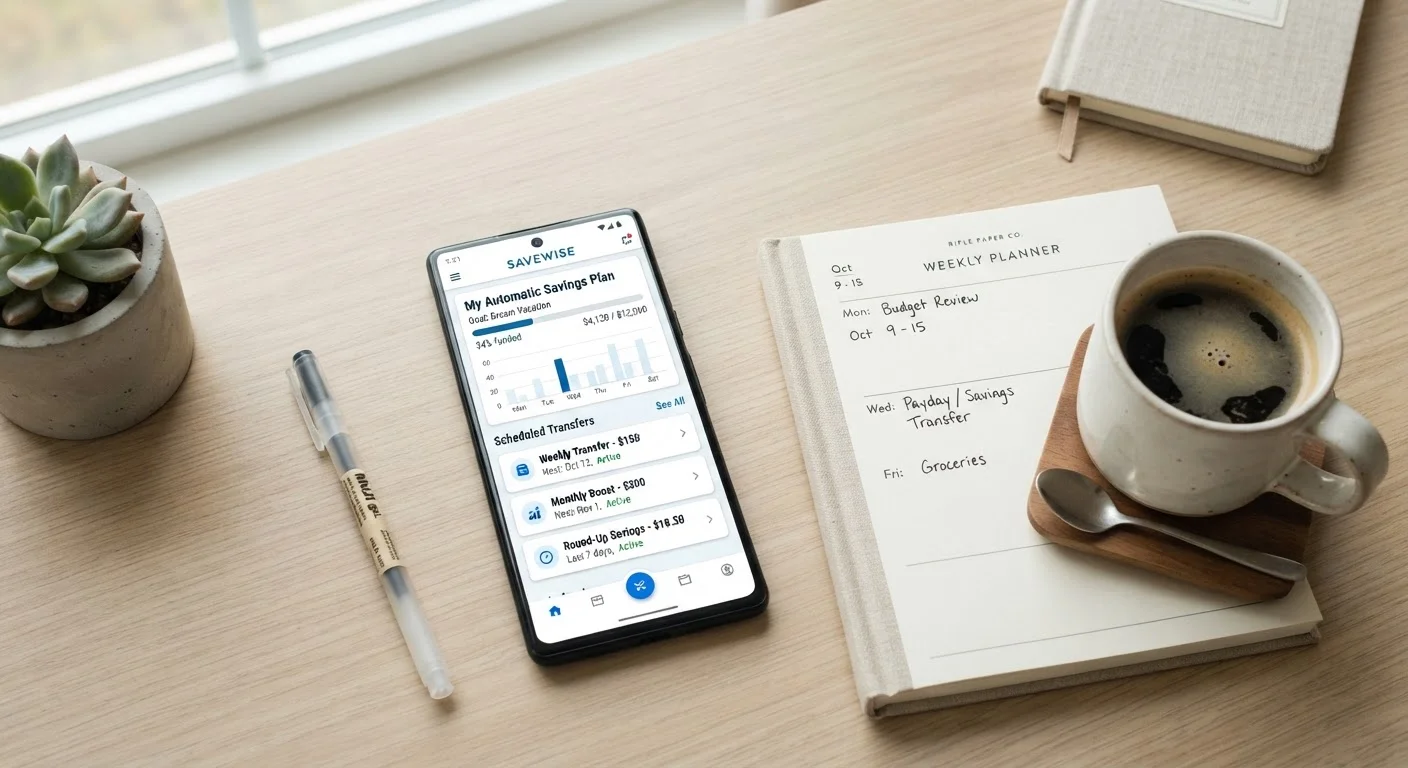
In practical terms, you set up a recurring transfer from your checking account to a separate savings account, scheduled for the same day your paycheck is deposited. Many employers also allow direct deposit splits, sending one portion directly to savings and the rest to checking - which means the money never passes through your spending account at all.
57%
Americans unable to cover a $1,000 emergency from savings
According to a Bankrate survey, more than half of U.S. adults would need to borrow or use credit to cover an unexpected $1,000 expense, highlighting how common the savings gap is.
1 day
Timing gap that matters most for saving success
Behavioral finance research suggests that transferring savings on the same day as a paycheck deposit - before any spending occurs - is significantly more effective than waiting even one day.
If your employer offers a 401(k) or similar retirement plan, contributions deducted from your paycheck before it hits your bank account are an even more seamless version of this concept. The money is allocated before you ever see it.
Because the transfer happens automatically, the habit doesn't depend on remembering, feeling motivated, or having a productive budgeting session. It runs in the background whether you think about it or not. For a balanced look at what automation does and doesn't solve, see our guide on automating your savings - trade-offs worth knowing.
Starting Small Is a Feature, Not a Compromise
A common hesitation is: "I don't have enough to make it worth it." But the pay-yourself-first principle is designed to work at any income level. The primary goal in the early stages isn't accumulation - it's establishing the behavior.
Start Smaller Than You Think You Need To
If you're unsure how much to automate, begin with an amount that feels almost too small - $10 or $20 per paycheck. The goal in the first month is to prove to yourself that the system works and that your budget can absorb the transfer. You can increase the amount once the habit feels natural and your account doesn't overdraft.
Research in behavioral economics consistently finds that small, regular actions build more durable habits than large, infrequent ones. Starting with $15 per paycheck and sticking to it for six months is more valuable - in terms of habit formation - than saving $200 once and stopping.
Once the transfer is running, you can increase the amount gradually as your income grows or your expenses shift. You're not locked in. The point is to begin, and to let the mechanism do the work. If you're truly starting from scratch, our article on saving money when you have almost none to start with walks through how to build from a zero base.
Where This Fits in Your Broader Financial Picture
Pay yourself first is a savings delivery mechanism, not a complete financial plan. It works best when paired with a clear destination for the money. Most financial educators suggest prioritizing an emergency fund before other savings goals - a dedicated cushion for unexpected expenses that prevents you from derailing other progress when something goes wrong. Our explainer on what an emergency fund actually is and why it comes first covers the reasoning in detail.
Beyond emergencies, the same automatic transfer approach applies to any goal: a travel fund, a down payment, or long-term retirement contributions. The mechanism is the same regardless of the destination. And because compound interest rewards consistency over size, the earlier and more regularly you deposit, the more time your money has to work.
If broader budgeting basics feel like the missing piece, that's worth exploring alongside this strategy - but don't wait for a perfect budget before starting. Set up the transfer first.
This article is for general informational and educational purposes only and does not constitute personalized financial advice. Consult a qualified financial professional for guidance specific to your situation.