
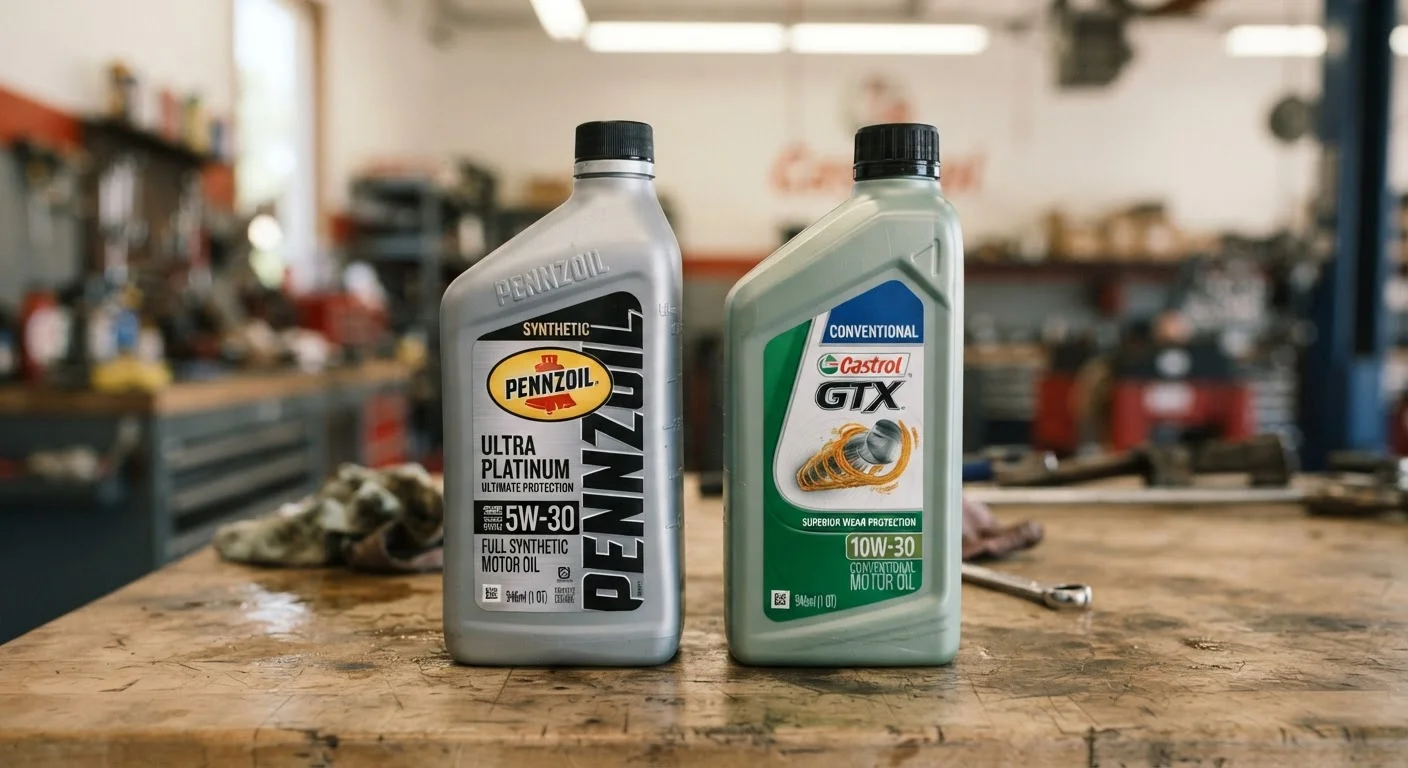
What Each Oil Type Actually Is
Motor oil's primary job is to lubricate your engine's moving parts, carry away heat, and suspend contaminants so they can be trapped by the oil filter. Both synthetic and conventional oils do this - but they start from very different places.
Conventional motor oil is refined directly from crude petroleum. During refining, many impurities are removed, but the base oil still contains naturally occurring molecular variations. This means its performance can shift more noticeably under stress - especially extreme heat or cold.
Synthetic motor oil is built from chemically engineered base stocks. Because molecules are designed to a uniform shape and size, synthetic oil flows more predictably, resists breaking down under heat, and maintains its protective properties longer. Most manufacturers of modern vehicles specify synthetic or synthetic-blend oil for these reasons.
One important note: neither oil type is inherently "better" if it doesn't match your vehicle's specified grade. A well-matched conventional oil is better than a synthetic that's the wrong viscosity. Always check the grade (for example, 5W-30) in your owner's manual first. Our guide to oil grades and change intervals explains how to read those numbers in plain language.
Performance Differences That Actually Matter Day-to-Day
For a new driver, the practical differences come down to three things: how the oil behaves in weather extremes, how long it lasts, and how it handles your specific engine type.
Cold Starts
When you start a cold engine, oil needs to reach all moving parts almost immediately. Conventional oil thickens significantly in very cold temperatures, slowing that critical first flow. Synthetic oil maintains better fluidity at low temperatures, which is particularly relevant if you live somewhere with hard winters.
Heat and Engine Stress
High engine temperatures - common in summer driving, towing, or in turbocharged engines - accelerate oil oxidation (breakdown). Synthetic oil resists this process more effectively, which is why turbocharged engines almost universally specify it.
Change Intervals
Conventional oil typically requires changing every 3,000 to 5,000 miles. Synthetic oil can last 7,500 to 10,000 miles or more depending on your vehicle - but your owner's manual defines the correct interval for your car, not general guidelines. See our breakdown of the 3,000-mile myth for context on why that old rule persists even when it no longer applies.
| Criterion | Synthetic Motor Oil | Conventional Motor Oil |
|---|---|---|
| Base composition | Chemically engineered base stocks | Refined crude petroleum |
| Typical change interval | 7,500-10,000+ miles (varies by vehicle) | 3,000-5,000 miles |
| Cold-weather performance | Flows better at low temperatures | Thickens more in extreme cold |
| High-temperature stability | Resists breakdown under heat | More prone to oxidation at high temps |
| Upfront cost per quart | Generally higher | Generally lower |
| Annual cost (accounting for intervals) | Comparable or lower over time | Can be higher due to more frequent changes |
| Availability | Widely available | Widely available |
| Suitability for turbo engines | Strongly recommended | Generally not recommended |
Cost: Breaking Down the Real Numbers
A common hesitation for first-time car owners is the higher sticker price of synthetic oil. It's worth thinking about annual cost rather than per-quart cost.
If conventional oil costs less per quart but requires changes twice as often as synthetic, the total annual spend can end up comparable - or synthetic can come out slightly lower when you factor in the labor or time involved. That said, exact figures vary widely based on your vehicle's oil capacity, the specific product, and local pricing. The general educational point holds: don't dismiss synthetic as unaffordable without looking at the full-year picture.
Blend (Semi-Synthetic) Is Also an Option
A synthetic blend mixes conventional and synthetic base stocks, offering better performance than straight conventional oil at a lower price than full synthetic. If your budget is a concern and your manufacturer permits it, a synthetic blend can be a reasonable middle ground - but always verify it meets your engine's specified oil grade and API service rating before using it.
If you're deciding whether to handle an oil change yourself or take it to a mechanic, our guide on DIY vs. professional maintenance walks through when each approach makes sense.
7,500+
Typical synthetic oil change interval (miles)
Many automakers specify intervals between 7,500 and 10,000 miles for full synthetic oil, though always defer to your vehicle's owner's manual.
~$10-$15
Approximate extra cost per quart for synthetic
Synthetic oil typically costs more per quart than conventional, though the gap varies by brand and formulation - general educational estimate, not a price guarantee.
This article is for general informational and educational purposes only. Always consult your vehicle's owner's manual and a qualified mechanic for advice specific to your car.