What a Credit Score Actually Represents
Think of a credit score as a report card for your borrowing habits - compressed into a single number. It doesn't measure your wealth, your income, or how financially responsible you feel. It measures one thing: how consistently you've repaid debt in the past, and what that pattern suggests about future risk.
That three-digit number is generated by a mathematical model that reads the data sitting in your credit report. Your credit report is a detailed record maintained by the three major credit bureaus - Equifax, Experian, and TransUnion. Lenders send updates to these bureaus regularly, and the bureaus compile that information into your report. The scoring model then processes that report and outputs a score.
Because the score is derived from your report, it's only as accurate as the data in it. That's why reading your credit report and checking it for errors is a smart habit, not just a financial chore.
716
Average US FICO Score
According to FICO's data, the average American FICO Score has hovered in the 'good' range in recent years, reflecting broad improvements in payment behaviour.
~45M
Credit-invisible Americans
The Consumer Financial Protection Bureau (CFPB) has estimated that tens of millions of Americans lack enough credit history to generate a scoreable file.
35%
Weight of payment history in FICO
FICO states that payment history is the single largest factor in its scoring model, accounting for approximately 35% of the total score.
The 300-850 Scale Explained
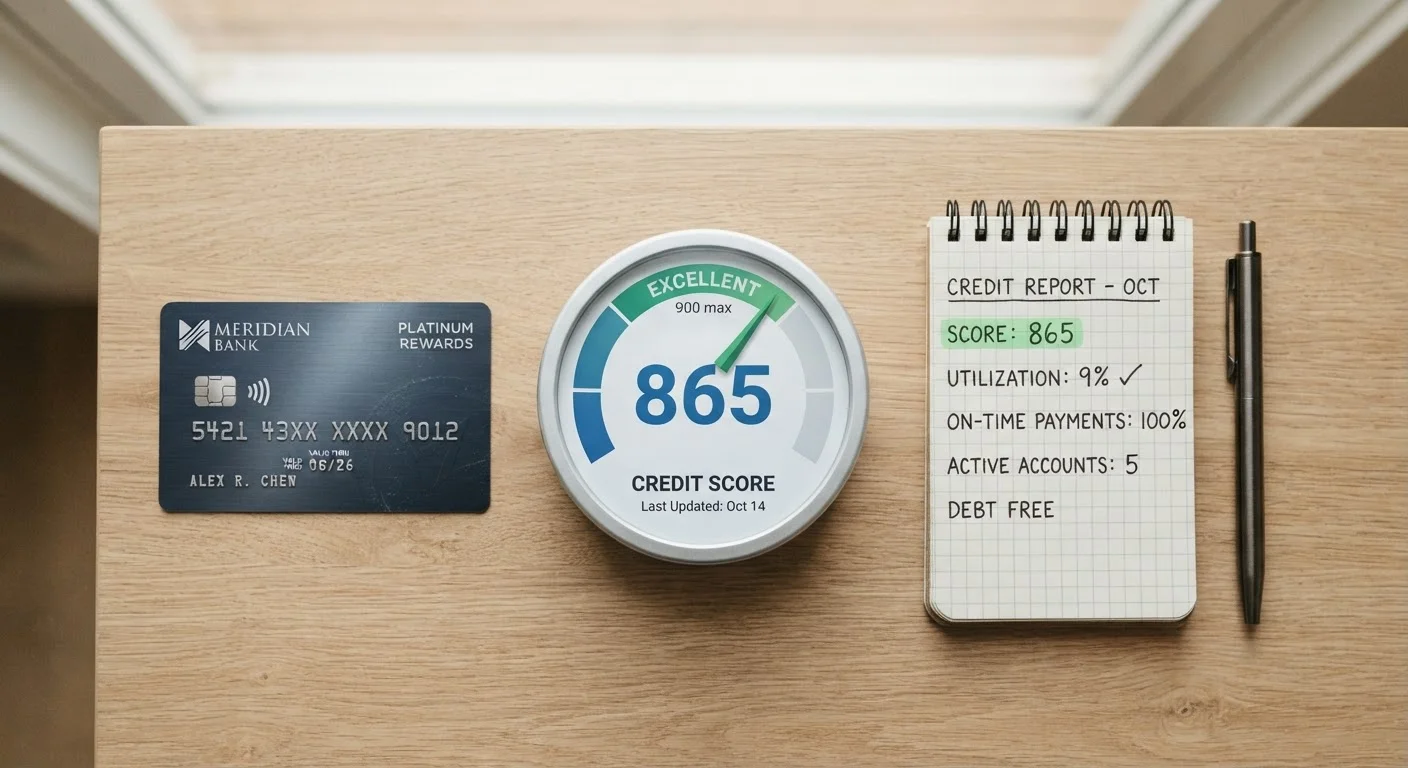
Both the FICO Score and VantageScore use a 300-to-850 range. The numbers themselves are somewhat arbitrary - what matters is where your score falls relative to common lender thresholds. Here's a general breakdown that most US lenders reference:
- 800-850 (Exceptional): You're seen as a very low-risk borrower and typically qualify for the most favourable terms.
- 740-799 (Very Good): You'll likely qualify for competitive rates across most loan types.
- 670-739 (Good): Near or above the average US score - most lenders consider this range acceptable.
- 580-669 (Fair): You may qualify for credit, but often at higher interest rates.
- 300-579 (Poor): Approval is difficult; secured cards or credit-builder loans are common starting points.
Interest rates can vary meaningfully across these bands. A borrower with an exceptional score may pay significantly less interest over the life of a loan than one with a fair score - even on the same loan amount. This is one of the most practical reasons to understand and care about your score.
Check Your Score Without Hurting It
Many banks, credit unions, and personal finance apps offer free access to your credit score with no impact on it. Checking your own score is classified as a 'soft inquiry' and is completely safe to do regularly. Making it a monthly habit helps you track progress and catch unexpected drops early.
What Goes Into the Calculation
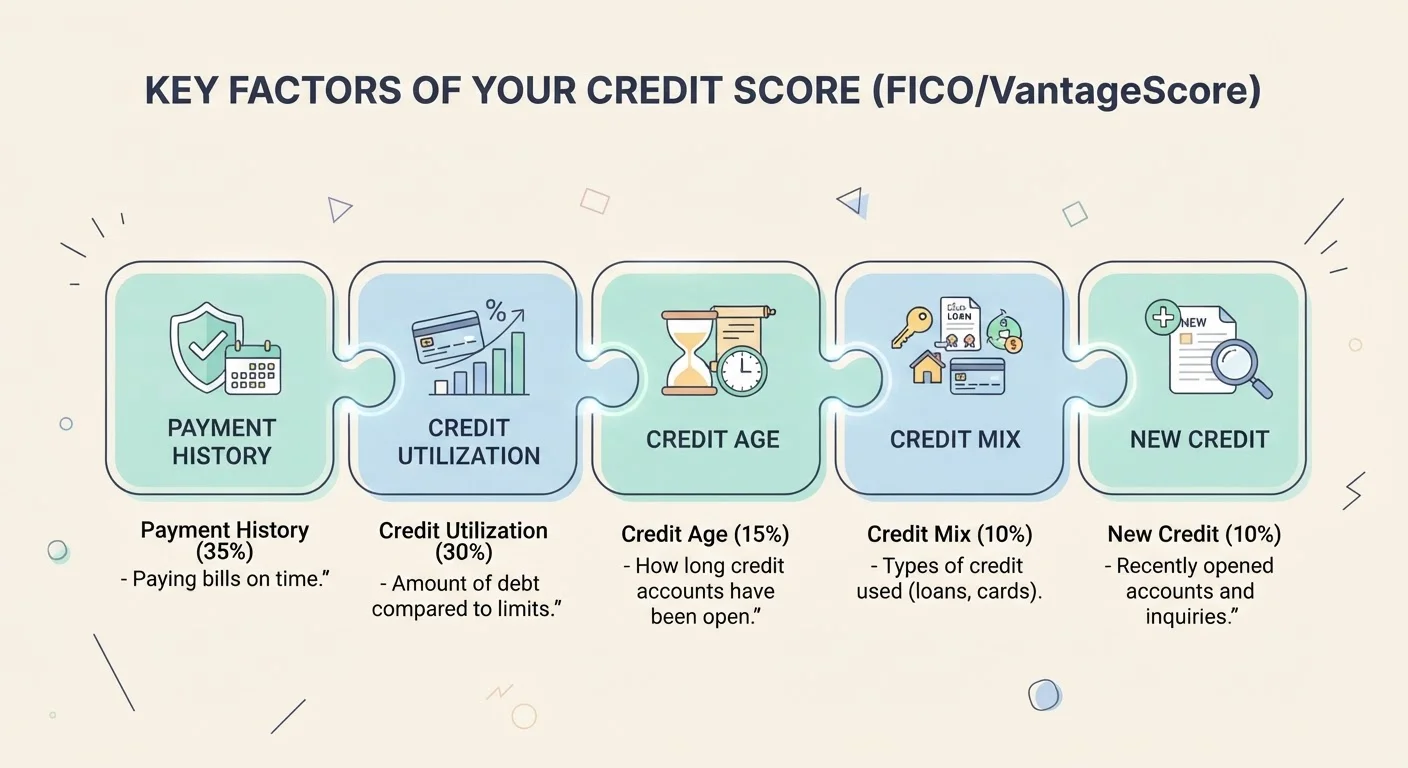
Your score is built from five broad categories of credit behaviour. While the exact weighting varies slightly between models, FICO's breakdown is widely cited as the industry standard. Payment history carries the most weight - paying on time, every time, is the single most powerful thing you can do for your score. Credit utilisation (how much of your available credit you're using) is the second biggest factor.
The remaining inputs - length of credit history, the mix of credit types you hold, and recent applications for new credit - round out the picture. Each factor tells lenders something different about your borrowing habits. For a detailed look at how much each factor actually moves the needle, see the five factors that shape your credit score.
One thing notably absent from the calculation: your income, savings balance, employment status, or net worth. A high earner with a history of missed payments can have a lower score than someone earning far less who pays every bill on time.
Why Lenders - and Others - Care About It
Lenders use your score to price risk. A lower score signals that lending to you carries more uncertainty, so they compensate by charging higher interest rates or declining applications altogether. A higher score signals reliability, which typically translates to lower rates and better terms.
But credit scores don't only appear in loan applications. Landlords often check scores when evaluating rental applications. Some employers in certain industries review credit history as part of background checks (with your permission, as required by law). Utility companies may check scores when deciding whether to require a security deposit.
Understanding your score - and what drives it - puts you in a stronger position across all of these situations. If you're curious about widespread misconceptions that trip people up, common credit score myths is worth reading alongside this article.
This article is for general informational and educational purposes only and does not constitute personalised financial advice. For guidance specific to your situation, consider speaking with a qualified financial professional.