Why Your Score Is Made Up of Five Pieces
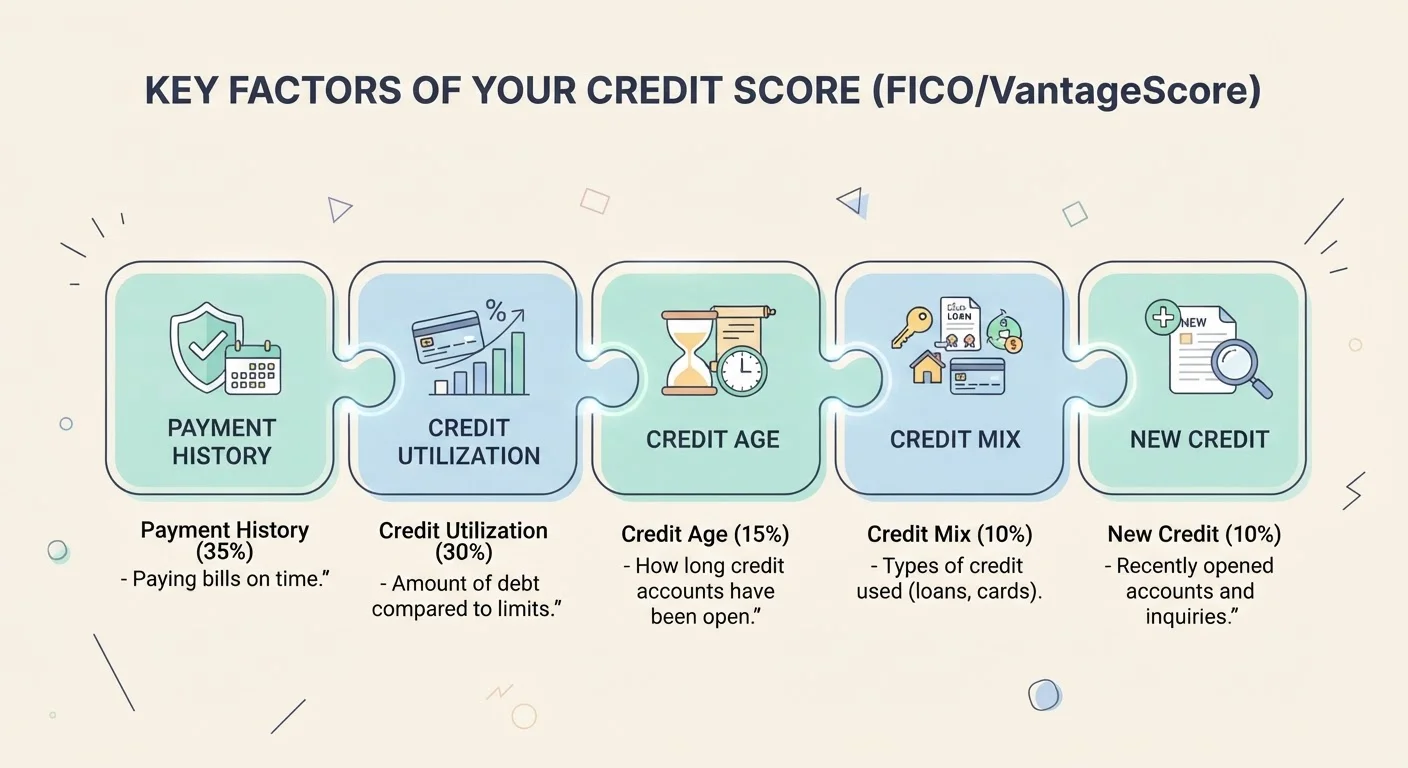
Your credit score isn't a mystery number plucked from thin air. Under the FICO scoring model - the most widely used framework by US lenders - your score is calculated from five specific categories of information in your credit report. Understanding those categories helps you see exactly which levers you can pull. For a broader look at what a credit score represents in the first place, see Credit Scores Decoded.
Each factor carries a different weight in the final calculation. Knowing the hierarchy means you can prioritize the right habits rather than spreading effort across things that barely move the needle.
The Five Factors, Explained
1. Payment History (35%)
This is the single largest factor. Lenders want to know: do you pay what you owe, on time? Every on-time payment is a positive data point; a payment that's 30 or more days late is a negative mark that can stay on your report for up to seven years. The good news is that older late payments carry less weight over time, especially as you build a consistent record of on-time payments afterward.
2. Credit Utilisation (30%)
Utilisation measures how much of your available revolving credit - typically credit cards - you're currently using. If you have a $5,000 limit and carry a $1,500 balance, your utilisation rate is 30%. Lower is generally better; many credit professionals suggest keeping utilisation below 30%, though the lower the ratio, the more favorably it tends to be viewed. For a detailed breakdown, see Credit Utilisation: The Ratio That Quietly Influences Your Score.
3. Length of Credit History (15%)
This factor looks at how long your accounts have been open - the age of your oldest account, your newest account, and the average age of all accounts combined. A longer history generally helps because it gives lenders more data to assess your habits. This is one reason financial educators often advise against closing old credit card accounts unnecessarily.
4. Credit Mix (10%)
Lenders like to see that you can responsibly manage different types of credit - for example, a combination of revolving credit (like a credit card) and installment loans (like a student loan or auto loan). You don't need every type of credit to have a strong score, and you should never take on debt purely to diversify your mix.
5. New Credit (10%)
Each time you apply for new credit, lenders typically perform a hard inquiry - a formal check of your credit report. Multiple hard inquiries in a short window can slightly lower your score and may signal financial stress to lenders. Rate-shopping for mortgages or auto loans within a focused period is generally treated as a single inquiry by scoring models, so that's less of a concern.
Credit Utilisation Rate
The percentage of your total available revolving credit that you're currently using. It's calculated by dividing your total balances by your total credit limits across all revolving accounts.
Hard Inquiry
A formal review of your credit report triggered when you apply for new credit. Hard inquiries are visible to other lenders and can slightly lower your score for a short period.
Revolving Credit
A type of credit account with a reusable limit, such as a credit card or line of credit. You borrow, repay, and borrow again up to the limit.
Installment Loan
A loan repaid in fixed, scheduled payments over a set term - for example, a student loan, auto loan, or personal loan.
FICO Score
A credit scoring model developed by the Fair Isaac Corporation and used by the majority of US lenders to evaluate a borrower's creditworthiness. Scores range from 300 to 850.
Putting It All Together
The most powerful insight from this breakdown is where to concentrate your energy: payment history and utilisation together account for 65% of your FICO score. Paying on time, every time, and keeping balances low relative to your limits will do more for your score than almost anything else.
The remaining three factors - history length, credit mix, and new credit - matter, but they tend to improve naturally over time as you build responsible habits. Avoid the temptation to game them with unnecessary account openings or closings. For a deeper look at long-term behaviours that keep a credit profile strong, see Habits That Support a Healthy Credit Profile Over Time. And if you've heard conflicting information about how scores work, Common Credit Score Myths That Keep People Confused can help you separate fact from fiction.
This article is for general informational and educational purposes only and does not constitute personalised financial or legal advice. For guidance tailored to your specific situation, consider speaking with a qualified financial professional.