
Why Credit Myths Are So Persistent
Credit scores can feel mysterious, and that mystery creates fertile ground for myths. A friend shares advice that sounds reasonable, a rumor circulates online, and suddenly a misconception becomes conventional wisdom. The problem is that acting on bad information can genuinely set back your financial progress.
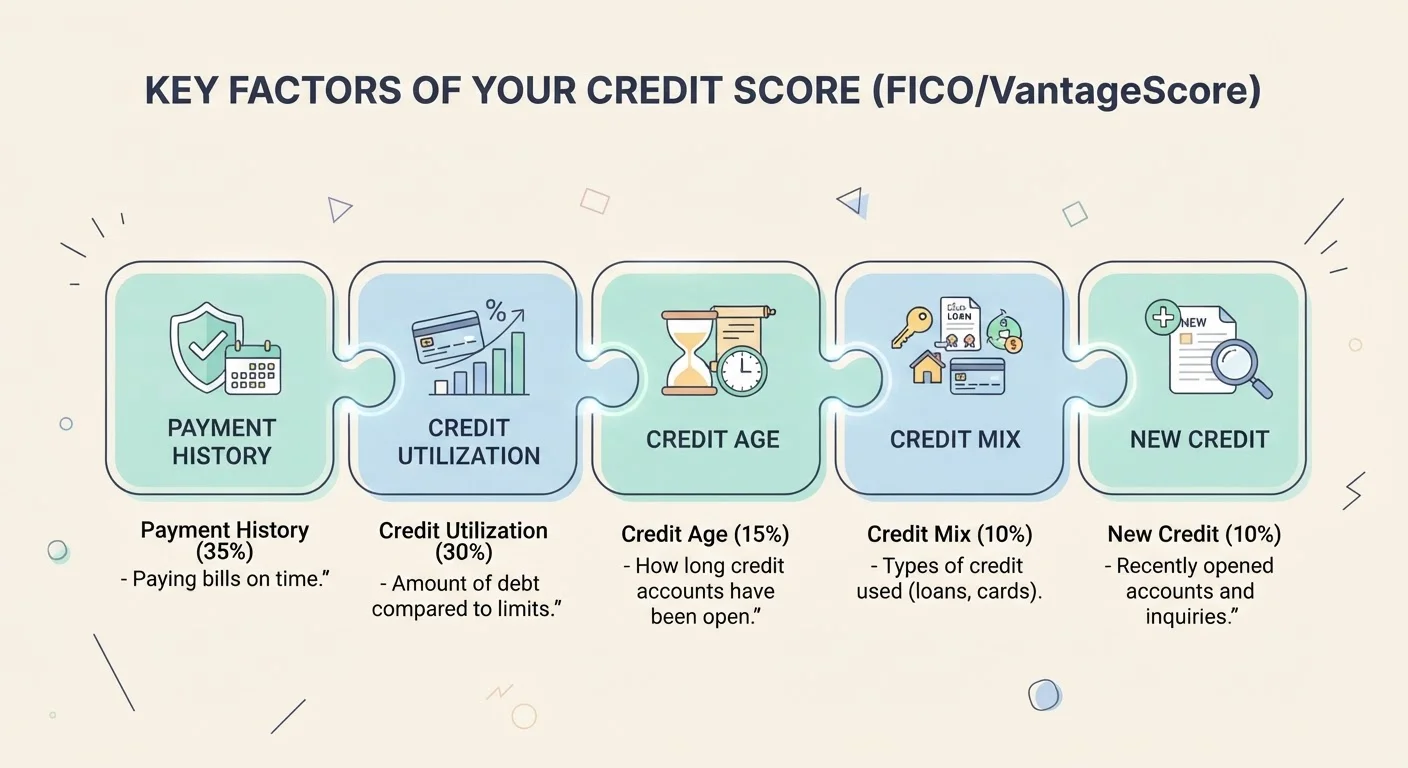
Your FICO score - the score most US lenders rely on - is calculated from five well-documented factors: payment history, credit utilisation, length of credit history, credit mix, and new credit. Understanding those factors is the starting point for cutting through the noise. For a plain-language breakdown, see the five factors that shape your credit score.
The myths below are among the most common ones beginners encounter - and the ones most likely to lead to costly decisions.
Myth
Checking your own credit score will lower it.
Fact
Checking your own score is classified as a soft inquiry and has no effect on your score whatsoever.
There are two types of credit inquiries: soft and hard. When you check your own score - through AnnualCreditReport.com or a credit monitoring service - it registers as a soft inquiry. Soft inquiries are invisible to lenders and carry zero scoring impact. Hard inquiries, by contrast, occur when a lender pulls your file as part of a formal credit application, and they can temporarily lower your score by a few points. Avoiding free credit-check tools out of fear of this myth can leave you uninformed about your own financial standing.
Myth
Closing an old credit card you never use is good for your score.
Fact
Closing an old card typically reduces your available credit and shortens your credit history - both of which can lower your score.
When you close a card, two things happen. First, your total available credit drops, which pushes your credit utilisation ratio (the percentage of available credit you are using) higher - and a higher ratio tends to hurt your score. Second, if the card is one of your oldest accounts, closing it can reduce the average age of your credit history over time. Length of credit history makes up a meaningful portion of your FICO score. Keeping an old card open with a zero balance is often the better move, unless there is a compelling annual fee reason to close it.
Myth
You need to carry a balance to build credit.
Fact
Paying your statement balance in full each month builds credit just as effectively - and avoids paying interest.
This myth may be the most financially costly one on the list. Lenders report your account activity to the credit bureaus regardless of whether you carry a balance. What matters is that you use the card and pay on time - not that you maintain a revolving balance. Carrying a balance month to month means paying interest charges for no scoring benefit. If you want to understand more about how card use compares to debit card use for building credit, credit cards vs. debit cards explains the practical differences clearly.
Myth
Your income affects your credit score.
Fact
Income is not a factor in any standard credit score model, including FICO.
Your credit score measures how you manage debt obligations, not how much you earn. A high earner who misses payments will have a lower score than a moderate earner who pays every bill on time. Income does appear on credit applications because lenders use it to assess your ability to repay, but that is a separate calculation entirely. Your score reflects behaviour - payment history, utilisation, account age - not the number on your paycheck.
Myth
A debit card helps build your credit history.
Fact
Debit card transactions are not reported to credit bureaus and have no impact on your credit score.
Debit cards draw directly from your bank account, so no credit is being extended and nothing is reported to Experian, Equifax, or TransUnion. If you are working on establishing credit, a secured credit card or a credit-builder loan are the tools typically recommended for that purpose - both involve actual credit reporting. Credit scores decoded offers a clear explanation of what the scoring system is actually tracking.
Myth
Settling a debt for less than you owe is just as good as paying it in full.
Fact
A settled account is recorded as 'settled for less than full amount,' which is viewed more negatively than 'paid in full.'
While settling a delinquent debt is better than leaving it unpaid, the notation that appears on your credit report matters. A settled account signals to future lenders that you did not fulfill the original obligation completely. The negative mark can remain on your report for up to seven years. If you have missed a payment and are worried about next steps, what happens to your credit when you miss a payment outlines the timeline and what recovery typically looks like.
Building Habits That Reflect the Facts
Knowing what the myths are is only half the work. The other half is replacing bad habits with ones grounded in how credit scoring actually operates.
35%
Payment history share of FICO score
According to FICO, payment history is the single largest factor in a standard FICO score calculation.
30%
Credit utilisation share of FICO score
FICO reports that amounts owed - closely tied to your utilisation ratio - account for roughly 30% of your score.
7 years
Typical negative mark duration on credit report
Under the Fair Credit Reporting Act, most negative items such as late payments and collections remain on your report for up to seven years.
The most reliable habits are also the least dramatic: pay every bill on time, keep your credit utilisation ratio low, and avoid opening or closing accounts impulsively. If you want to go deeper on the utilisation piece - which surprises many beginners - credit utilisation and how it quietly influences your score walks through exactly how the math works.
If you are ready to look at your actual credit file, reading your credit report without getting lost explains each section in plain terms and shows what to look for. And for the long game, habits that support a healthy credit profile over time outlines the steady behaviours that tend to keep a credit profile in strong shape over years, not just months.
This article is for general informational and educational purposes only and does not constitute personalised financial advice. For guidance specific to your situation, consider speaking with a qualified financial professional.