
What You're Actually Comparing
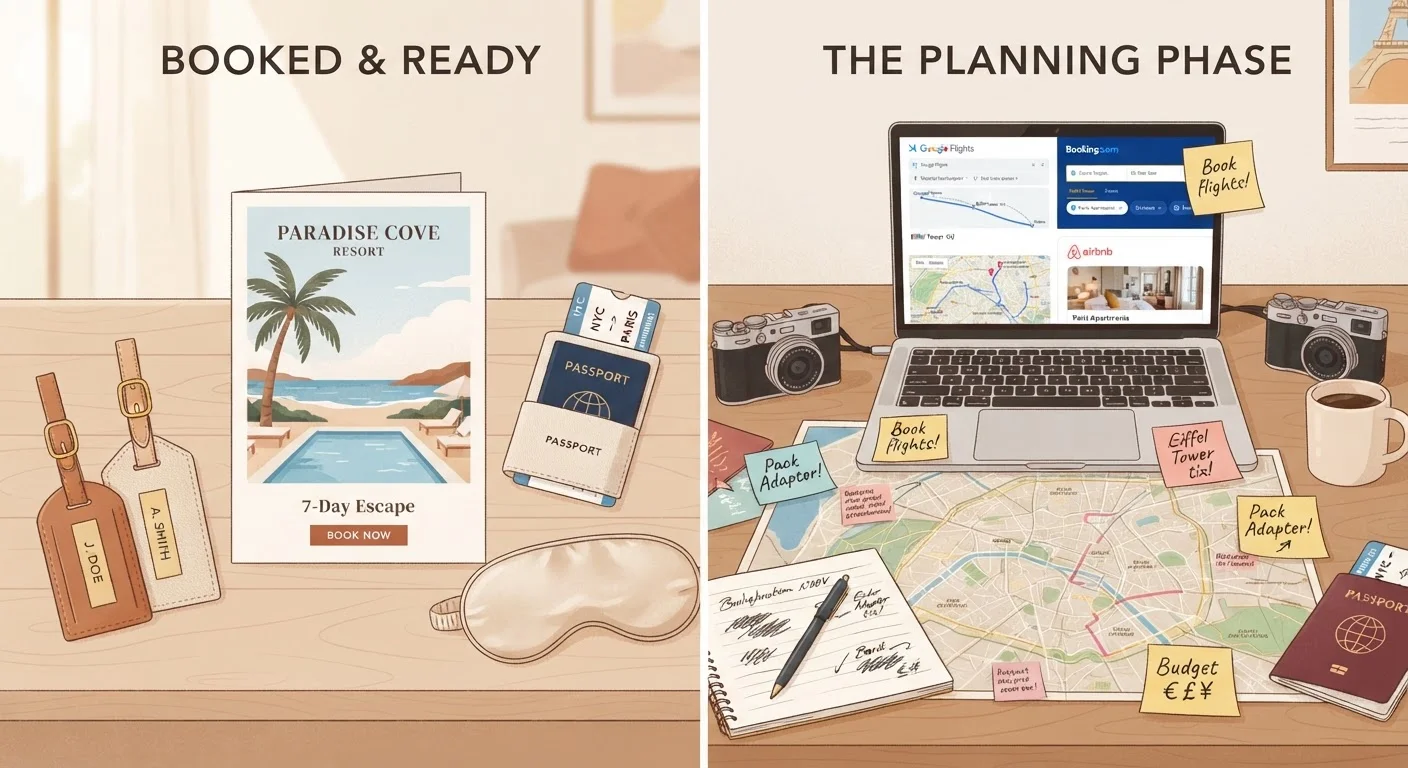
A package holiday - sometimes called an all-inclusive or bundled trip - combines at minimum flights and accommodation into a single booking, usually through a tour operator or travel company. Many packages add airport transfers, meals, and excursions. You pay one price, receive a confirmation, and show up.
A self-planned trip means booking each element separately: flights on one platform, accommodation on another, transfers arranged independently, and activities sourced yourself. You control every decision - but you're also responsible for every decision.
The gap between these two approaches isn't just about cost. It's about how much time, research, and decision-making you want to own. For a fuller breakdown of building a trip component by component, see our complete walkthrough for first-time travellers.
The Case for a Package Holiday
Package deals exist because they solve a real problem: most people don't have unlimited time to research and coordinate travel logistics.
Single booking covers major logistics
Flights, accommodation, and often transfers are bundled - you won't miss a connection and leave your hotel booking stranded.
Upfront cost clarity
You know the total cost at booking rather than watching it accumulate across multiple platforms and add-ons.
Consumer protections in many package deals
In the US and many other markets, licensed package operators carry certain liability obligations if components fail - for example, if a hotel is unavailable, they must find an alternative.
Minimal research time required
The operator handles destination knowledge, logistics, and coordination - useful if you're time-poor or traveling somewhere unfamiliar.
Lower stress for first-time international travelers
Having a confirmed, coordinated itinerary reduces anxiety for travelers who have never navigated international airports or unfamiliar transit systems.
One practical note - package pricing can sometimes be competitive with self-booking, especially for popular sun-and-beach destinations where operators buy flights and rooms in bulk. However, this is not guaranteed, and prices vary widely by operator, season, and destination. Always compare before assuming either option is cheaper.
The Case for Self-Planning
Planning a trip independently gives you a level of control that no package can match. You choose the exact neighborhood, the check-in and check-out times, the pacing, and the experiences.
Full flexibility and control over every detail
You choose the exact hotel, neighborhood, flight times, and pace - decisions a package operator makes for you.
Ability to adjust the trip mid-travel
Extend a stay, skip a city, or change accommodation if a place doesn't suit - self-planned itineraries can flex in ways packages generally cannot.
Can access unique or off-the-beaten-path stays
Guesthouses, locally run boutique hotels, and remote accommodations are rarely included in packages, which typically favor larger, standardized properties.
Potentially lower cost for the right destinations
For destinations where budget accommodation and transport are widely available, self-booking can meaningfully undercut a packaged equivalent.
Full responsibility for every booking and problem
If a flight is cancelled, a hotel overbooks, or a tour doesn't run, you're negotiating resolutions yourself - sometimes in a foreign language or time zone.
Significant time investment required
Researching flights, accommodation options, transport logistics, visa requirements, and activities can consume many hours before a trip even begins.
The effort trade-off is real. Research from travel behavior studies consistently shows that independent trip planning takes significantly longer than most travelers anticipate - particularly for international destinations involving multiple transit points, visa requirements, or unfamiliar transport systems. If you go this route, our guide on when to book what will help you sequence decisions without doubling back.
Cost: The Honest Picture
Cost is the most commonly cited factor in this decision - and the hardest to generalize about.
40%+
Travelers who report feeling overwhelmed by trip planning
Industry surveys consistently find a significant share of leisure travelers cite the research and booking process itself as a source of stress.
8-15 hrs
Estimated time to self-plan a first international trip
Travel planning advisors frequently estimate this range for first-time independent international travelers, excluding time spent on visa applications.
Package holidays can undercut self-booking for specific destinations - particularly short-haul European beach resorts or Caribbean all-inclusives - where operators negotiate bulk rates that individual travelers can't access. On the other hand, self-planning a trip to Southeast Asia, Central America, or less-touristy destinations often comes out cheaper because accommodation and local transport are inexpensive and packages for those regions carry higher markups.
Hidden costs also shift the calculation. Self-planners frequently overlook expenses like airport transfers, city taxes, checked baggage fees on budget airlines, and the time cost of hours spent researching and booking. Package travelers may underestimate costs for meals outside an included plan or excursions not bundled in. For strategies on reducing out-of-pocket travel spend overall, see our budget travel tips hub.
One useful comparison method: build a full itemized estimate for a self-planned version of your trip, then compare it against a package quote for the same dates and destination. The gap - in either direction - will be your real answer.
Flexibility vs. Certainty
This is the core trade-off, and it plays out in two main ways.
Before you travel: Self-planners can adjust anything right up to departure - swap hotels, change flight times, extend the trip. Package travelers are generally locked into the itinerary; changes are possible but typically involve fees or may not be available at all.
During the trip: A package removes daily logistics decisions. Your room is booked, the transfer is confirmed, and if something goes wrong with the airline component, your tour operator typically has a duty-of-care obligation to rebook or find alternatives. Self-planners have full control day-to-day but absorb every disruption personally - a missed connection, a closed hotel, a cancelled tour all become your problem to solve in real time.
How comfortable you are with ambiguity matters here. If a delayed flight and a scramble to rebook accommodation sounds stressful rather than adventurous, that's useful self-knowledge. If you'd rather have the freedom to pivot - skip a destination, add a night somewhere unexpected - self-planning earns that.
A Hybrid Option Worth Considering
Some travelers use a partial package - booking a flight-and-hotel bundle for the main destination, then self-arranging day trips and activities. This approach captures some cost certainty while preserving day-to-day flexibility. It's worth exploring if you find neither extreme fits your needs. Check what each bundle actually includes before assuming it's a full package.
Trip duration also affects this balance considerably - the longer and more complex a trip, the more planning overhead self-booking accumulates. Our article on how planning complexity scales with trip length covers that in detail.