Start With What You Actually Want
Most first-time trip planners open a browser and immediately start searching destinations - and quickly feel buried. The smarter move is to start one step earlier: figure out what you actually want from this trip before you pick anywhere to go.
Ask yourself three questions: How many days do I have? What's my rough spending limit? Do I want to relax, explore, or experience something specific? Answering these narrows the destination list from infinite to manageable. A five-day trip on a tight budget calls for a very different destination than an open-ended adventure. If you're weighing how much complexity scales with trip length, see our guide on short vs. long trip planning.
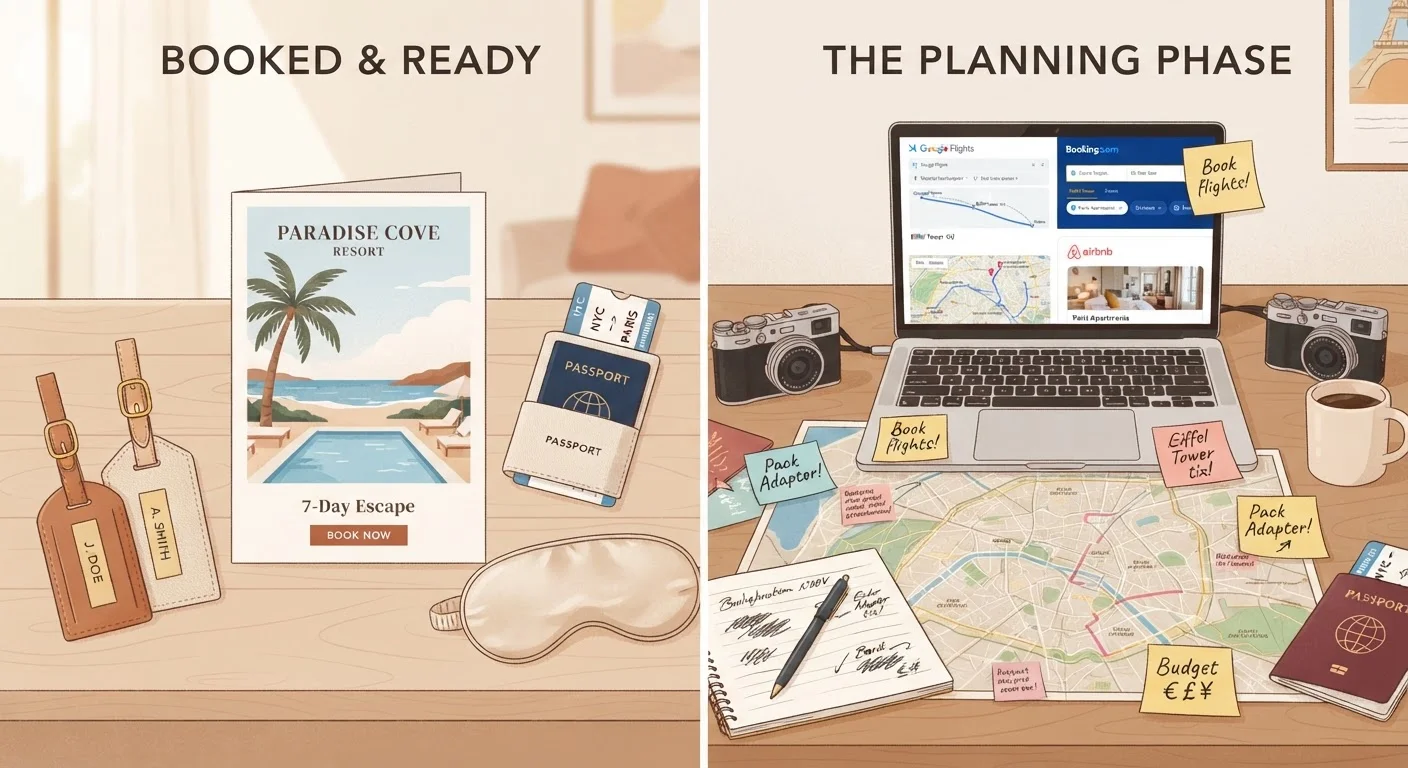
Also consider whether you want to plan everything yourself or hand some of it off. Package holidays and self-planned trips each come with trade-offs - cost, flexibility, and effort - worth understanding before you commit to either path.
Before choosing a destination, write down your non-negotiables - beach vs. city, warm vs. cool, active vs. slow - and let those filter your options rather than starting with a list of everywhere.
Starting with personal criteria rather than a destination list dramatically narrows decision fatigue and produces a trip that actually fits what you want.
If you're genuinely unsure where to go, pick a destination within a four-hour flight or drive from home for your first trip. Shorter transit means fewer logistics to manage while you're still learning the process.
Proximity reduces visa complexity, cost, and the consequences of planning errors - giving you room to learn without high stakes.
Set a Realistic Budget Before Booking Anything
Budget is the framework everything else fits inside. Without a clear number, it's easy to book flights you can afford but accommodation you can't, or to arrive somewhere and realize daily costs are double your estimate.
A trip budget has six core buckets: transportation to and from your destination, accommodation, daily food, local transportation, activities, and a buffer (typically 10-15% of the total). Don't skip the buffer - unexpected costs are a near-certainty, not a remote possibility.
Research average daily costs for the destination you're considering before committing to it. Travel cost databases, government travel pages, and community forums can give you ballpark figures. For a deeper dive into making the numbers work, our first budget trip abroad guide covers destination selection through daily spending management. General budgeting strategies are also covered across our Budget Travel Tips hub.
6+ weeks
Typical passport processing lead time
Processing times vary by country and application volume; expedited services may be available but are not guaranteed.
10-15%
Recommended trip budget buffer
Travel planning guides broadly recommend reserving a contingency fund to cover unexpected costs during any trip.
2-3
Anchoring activities per day recommended
Experienced travellers and trip planners consistently advise limiting planned activities to avoid exhaustion and missed experiences.
Handle Documents and Entry Requirements Early
This is the step most first-timers underestimate, and it's the one most likely to cause real problems. Passport processing can take several weeks; some countries require your passport to be valid for six months beyond your travel dates. Visa applications for certain destinations require even longer lead times, supporting documents, and sometimes an in-person appointment.
Check official government sources - specifically your country's foreign affairs department and the destination country's embassy website - for current entry requirements. Do not rely on travel blogs or forums for visa rules; these change and are frequently out of date.
Also research whether any vaccinations are recommended or required for your destination. For a grounded overview of health and safety considerations, see our travel safety guide for first-timers. Consult a healthcare provider well in advance if vaccinations may be needed - some require multiple doses over several weeks.
Entry requirements, visa rules, and vaccination recommendations are subject to change. Always verify with official government and embassy sources before travelling.
Build Your Itinerary Without Overpacking It
An itinerary is a loose framework, not a minute-by-minute schedule. The most common first-timer mistake is filling every hour, then arriving exhausted and spending the trip running between things they only half-enjoyed.
A practical rule: plan no more than two or three anchoring activities per day. Leave time for meals, transit between places, and unplanned moments. Factor in realistic travel times between locations - distances on a map rarely reflect how long it actually takes to get somewhere by bus, train, or foot.
Be aware of common planning assumptions that catch travellers off guard - underestimating transit time and overestimating how much a destination packs into a single day are near-universal first-trip errors.
Book in the Right Order
Booking order matters because some decisions constrain others. The general sequence that reduces wasted effort: confirm travel dates → book flights or main transport → book accommodation → arrange activities or tours.
Flights determine your arrival and departure points, which determines which accommodation options are practical. Booking accommodation before flights can leave you committed to a location your flight doesn't conveniently serve. Activities and tours are typically the most flexible and can often be booked closer to your trip - some are best reserved in advance for popular sites, but most don't need to be locked in months ahead.
Travel insurance is worth arranging shortly after booking your flights, not as an afterthought before departure. Coverage for cancellations typically applies only if you purchase the policy before a problem arises. This is general information - read any policy carefully and consult the provider with questions about what is and isn't covered.
Pack Smart and Prepare to Leave
Packing is the last step, not the first - but it's where preparation pays off. Start with a packing list based on your destination's climate, planned activities, and trip duration. Lay everything out before putting it in a bag, then cut roughly a third of it. Most first-time travellers overpack.
In the final week before departure, run a structured pre-trip review. Confirm bookings, check passport expiry again, ensure digital copies of key documents are accessible, and notify your bank of travel dates if you'll use your card abroad. Our pre-trip checklist covers everything worth verifying before you leave home - from travel insurance confirmation to emergency contact setup.
Planning a trip for the first time takes more effort than it looks, but the process is learnable and repeatable. Each trip you plan gets faster. The goal for this one is simply to leave prepared and arrive with realistic expectations - that's a successful first trip.