Why Parallel Parking Feels Hard (And Why It Doesn't Have to Be)
Parallel parking intimidates new drivers for a simple reason: it requires the car to move in a curved path while reversing, which is the opposite of how most people learn to steer. Add the pressure of traffic waiting behind you, and the anxiety spikes quickly.
The good news is that parallel parking follows a repeatable, geometric sequence. Once you understand why each steering input happens - not just that it does - the process becomes predictable. Developing a calm, observant mindset matters here too: scanning your surroundings before you begin is as important as the steering itself.
Before you practice on a busy street, spend time in an empty parking lot using cones or chalk lines to simulate two parked cars. That environment removes social pressure and lets you focus on learning the geometry.
What you will need
Understanding Space and Setup
The single biggest reason parallel parking attempts fail is choosing a space that is too small. As a general rule, the gap should be at least 1.5 times the length of your vehicle - so if your car is 15 feet long, look for a space of at least 22-23 feet. Trying to squeeze into a shorter space dramatically increases the chance of contact with surrounding vehicles.
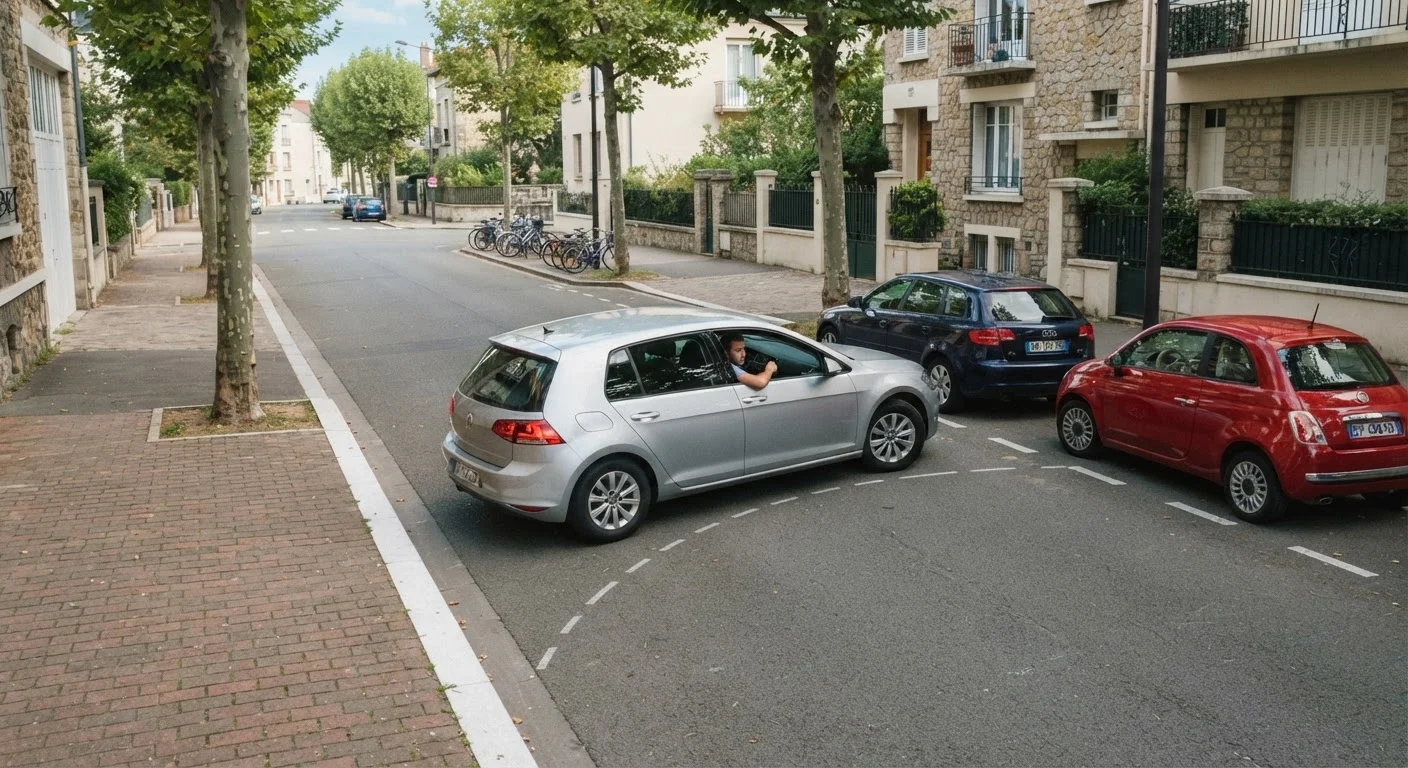
Once you identify a usable space, signal your intention early, check your mirrors, and pull up parallel to the car in front of the space. Aim to position your vehicle so that:
- Your car is roughly 2-3 feet away from the parked car beside you (laterally).
- Your rear bumper is approximately even with the rear bumper of the front parked car.
This starting alignment is critical. If you begin too far forward or too far back, correcting mid-maneuver becomes much harder. Take an extra moment to get this right - traffic behind you can wait a few seconds.
Pick Your Reference Points Before You Move
Every car has fixed visual reference points - a door handle, a window pillar, a line in the hood - that line up predictably with objects outside. Spend a few minutes in a parked car identifying what you can see in each mirror at various distances from a curb. Knowing these points in advance means you won't be guessing mid-maneuver.
Step-by-Step: The Three-Turn Method
The technique below assumes a standard right-side parking space. Reverse the steering directions for left-side spaces.
Signal and check all mirrors and blind spots
Before reversing, activate your right turn signal and check your driver-side mirror, passenger-side mirror, and rear-view mirror. Physically look over your right shoulder to check the blind spot for cyclists or pedestrians. This scan should take no more than five seconds but is non-negotiable for safety.
Reverse slowly and steer sharply right
Begin reversing at a slow, controlled speed - roughly walking pace. As soon as you start moving, turn your steering wheel toward the curb (right). A useful reference point: begin this turn when your rear bumper is roughly even with the rear bumper of the car in front of the space. Continue steering right as your car angles into the space at roughly 45 degrees.
Straighten the wheel, then steer left
When your front bumper clears the rear bumper of the front parked car, straighten the wheel momentarily, then steer sharply left (away from the curb). This swings your front end into the space and brings the car increasingly parallel to the curb. Watch your passenger-side mirror to monitor your distance from the curb as you do this.
Straighten and stop when parallel to the curb
As the car straightens up inside the space, gradually straighten the steering wheel. Stop when you are approximately 6-12 inches from the curb and centered within the space. In most US jurisdictions, parking more than 12 inches from the curb is technically a violation, so aim to get close without contacting it.
Adjust position within the space if needed
If you are too far forward or backward within the space, use short pull-forward or push-back adjustments with gentle steering corrections to center yourself. Aim to leave roughly equal space in front and behind your car. Once satisfied, shift into Park (or neutral with the parking brake engaged on a manual), and turn off your signal.
If you make contact with a curb or come close to a surrounding vehicle, don't panic - simply pull forward a few feet to reset, then re-enter the space. Minor adjustments after the initial maneuver are completely normal, even for experienced drivers.
Building good low-speed habits now pays off beyond parking. Understanding stopping distances and spatial awareness will make you a more confident driver in all situations.
Common Mistakes and How to Fix Them
Even with the right technique, new drivers run into predictable errors. Here's what typically goes wrong and how to correct it:
| Mistake | What it looks like | Correction |
|---|---|---|
| Starting too close to the front car | Front bumper swings into traffic on the first turn | Pull forward to re-establish the 2-3 ft gap before trying again |
| Turning the wheel too late | Car slides too far back before angling in | Use a fixed reference point - turn when your rear axle clears the front car's bumper |
| Not straightening in time | Rear end strikes the curb or rear car | Check your passenger-side mirror continuously; straighten when the curb is 6-8 inches away |
| Finishing at an angle | Front wheels point away from the curb | While still in the space, pull slightly forward and steer toward the curb to level out |
If your car has a backup camera or parking sensors, use them as supplementary information - not your primary guide. Learning to park without relying solely on technology means you'll be capable in any vehicle you drive.
Always Re-Check Blind Spots Between Movements
Cyclists and pedestrians can enter the space around your car quickly and silently. Any time you shift from reversing to pulling forward - or pause mid-maneuver - take a fresh scan of your mirrors and blind spots before continuing. Never assume the area is still clear just because it was a moment ago.