Why These Numbers Matter More Than You Think
Physics doesn't care how experienced a driver you are. The gap between knowing a number and truly understanding what it means in motion is where most new-driver errors live. Speed limits, stopping distances, and following gaps are the three interconnected figures that shape nearly every driving decision you make - and getting any one of them wrong can have serious consequences.
This guide breaks down the most common misunderstandings around each figure, explains why they happen, and gives you concrete ways to apply them correctly. For a deeper look at how road conditions compound these figures, see our article on what actually affects stopping distance.
Treating the speed limit as the appropriate speed in all conditions.
Why it happens: New drivers learn speed limits as fixed rules and default to them as the correct speed, rather than understanding them as legal ceilings that context can lower.
Counting only braking distance and ignoring reaction distance when estimating how long it takes to stop.
Why it happens: Braking distance is the more intuitive part - the part where the car visibly slows. Reaction time is invisible, so it tends to be discounted or forgotten entirely.
Applying the two-second following rule regardless of speed, load, or road conditions.
Why it happens: The rule is taught as a single, portable figure, so drivers apply it universally without adjusting for context - treating it as a complete answer rather than a baseline.
Underestimating how dramatically stopping distance grows with small speed increases.
Why it happens: Speed feels roughly linear - 70 mph feels only a little faster than 60 mph. But because braking distance increases with the square of speed, the difference in stopping distance is much larger than the speed difference suggests.
Following a large vehicle at the same distance used for a passenger car.
Why it happens: Drivers calibrate following distance based on the back of the vehicle ahead without accounting for the fact that larger vehicles block visibility and take longer to stop themselves.
Speed Limits: What the Sign Is Actually Telling You
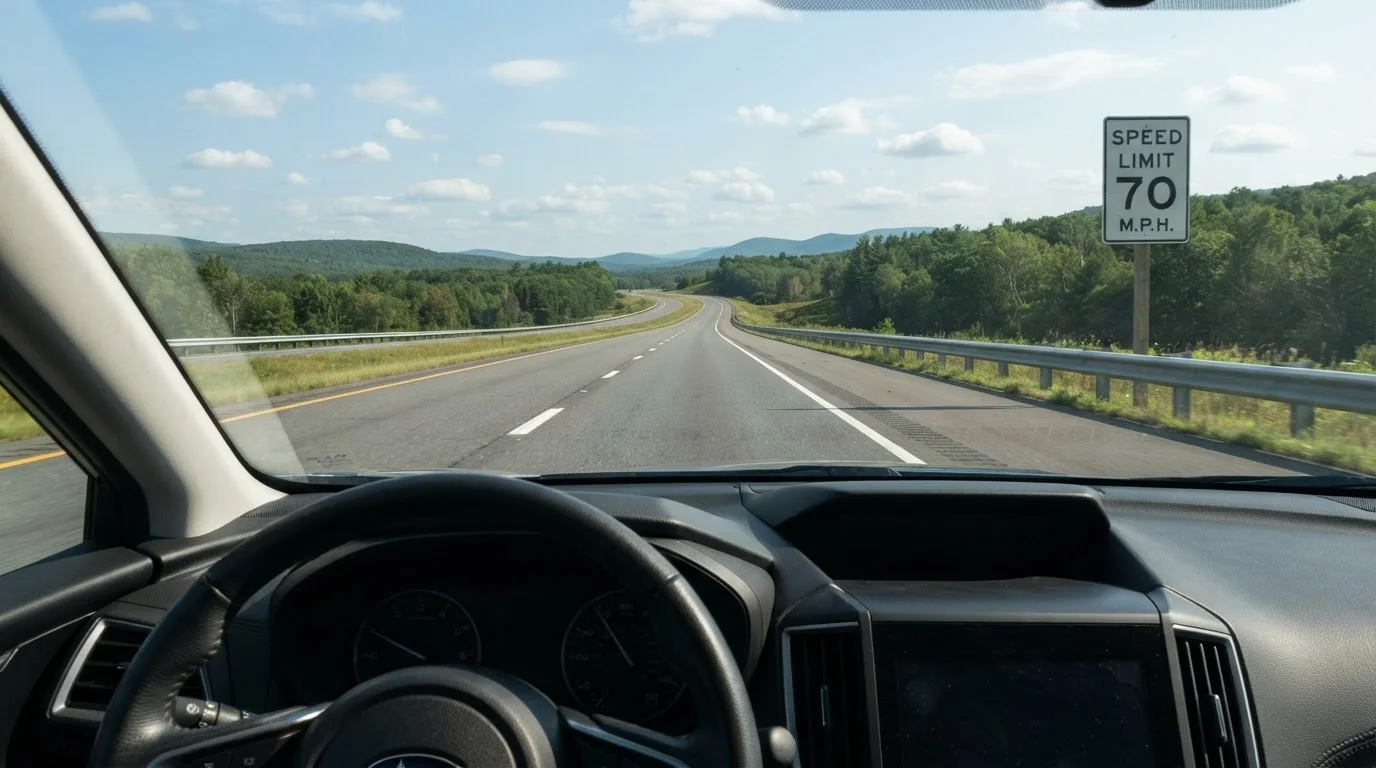
Speed limits define the maximum legal speed under ideal conditions - dry pavement, good visibility, light traffic, and a fully alert driver. They are not a suggested target or a floor to build up from. Many new drivers treat a posted 55 mph limit as permission to drive 55 mph regardless of what's happening around them. Rain, fog, heavy traffic, or a curve ahead all call for lower speeds even when the sign says otherwise.
Understanding this distinction also matters financially. Driving over the posted limit - even by a small margin - can affect insurance premiums and result in fines. See our overview of real car ownership costs for context on how driving behavior connects to expenses.
~132 ft
Distance covered during reaction time at 60 mph
Based on an average human reaction time of approximately 1.5 seconds - before braking even begins.
4×
Braking distance increase when speed doubles
Because braking distance scales with the square of speed, doubling your speed roughly quadruples the distance needed to stop.
3-4 sec
Recommended following gap on wet or fast roads
Safety guidelines widely recommend extending the two-second rule to at least three or four seconds when conditions are less than ideal.
Stopping Distance: The Math New Drivers Consistently Get Wrong
Stopping distance has two components that are often treated as one: reaction distance (the distance your car travels while your brain registers a hazard and your foot reaches the brake) and braking distance (the distance needed after braking begins). At 60 mph, average reaction distance alone is roughly 66 feet before the brakes even engage.
The relationship between speed and stopping distance isn't linear - it's exponential. Doubling your speed roughly quadruples your braking distance. A car traveling 60 mph needs approximately four times the braking distance of the same car at 30 mph. This is why even modest speed reductions in hazardous conditions make a significant safety difference.
Conditions that extend stopping distance beyond the baseline include wet or icy roads, worn tires, a heavily loaded vehicle, and driver fatigue or distraction. The impact of distraction on reaction time is frequently underestimated by new drivers.
Stopping Distance Is Not a Single Number
The figures cited in driver education are calculated under controlled, ideal conditions. Real-world stopping distances vary significantly with tire tread depth, road surface, weather, vehicle weight, and driver alertness. Do not assume a memorized figure applies to your exact situation. Always leave more space than you think you need.
Following Gaps: More Than a Two-Second Rule
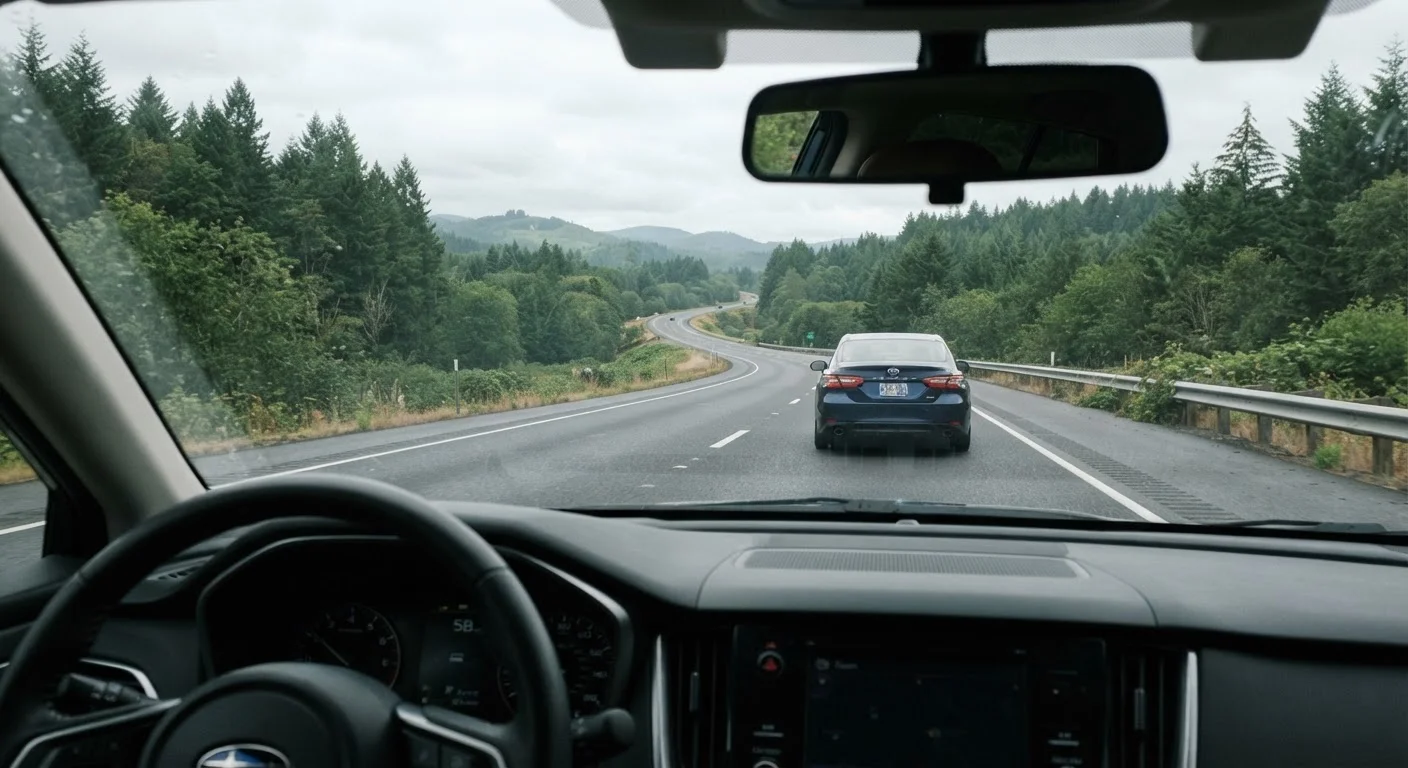
The two-second following rule - choosing a fixed point and ensuring two full seconds pass before your car reaches it - is widely taught and genuinely useful as a starting point. But it's a minimum under ideal conditions, not a universal rule. At highway speeds or in adverse weather, safety advocates and researchers consistently recommend three to four seconds or more.
Large vehicles such as trucks and SUVs require longer following distances both because they take longer to stop and because they block your view of hazards ahead. If you're following a truck and can't see the road beyond it, you're too close. Our guide on when two seconds isn't enough walks through exactly when you need significantly more space.
New drivers on highways face particular pressure to close gaps due to faster traffic - a challenge explored in our first-time highway driving guide. Resisting that pressure is one of the most protective habits you can build early.
Tailgating Has Consequences Beyond a Crash
Driving too close to the vehicle ahead doesn't just raise your crash risk - it also contributes to mechanical wear through frequent hard braking and can result in traffic citations in many states. Consistent tailgating is also associated with higher insurance premiums over time. Our article on the costs of aggressive driving covers the financial and mechanical impact in detail.