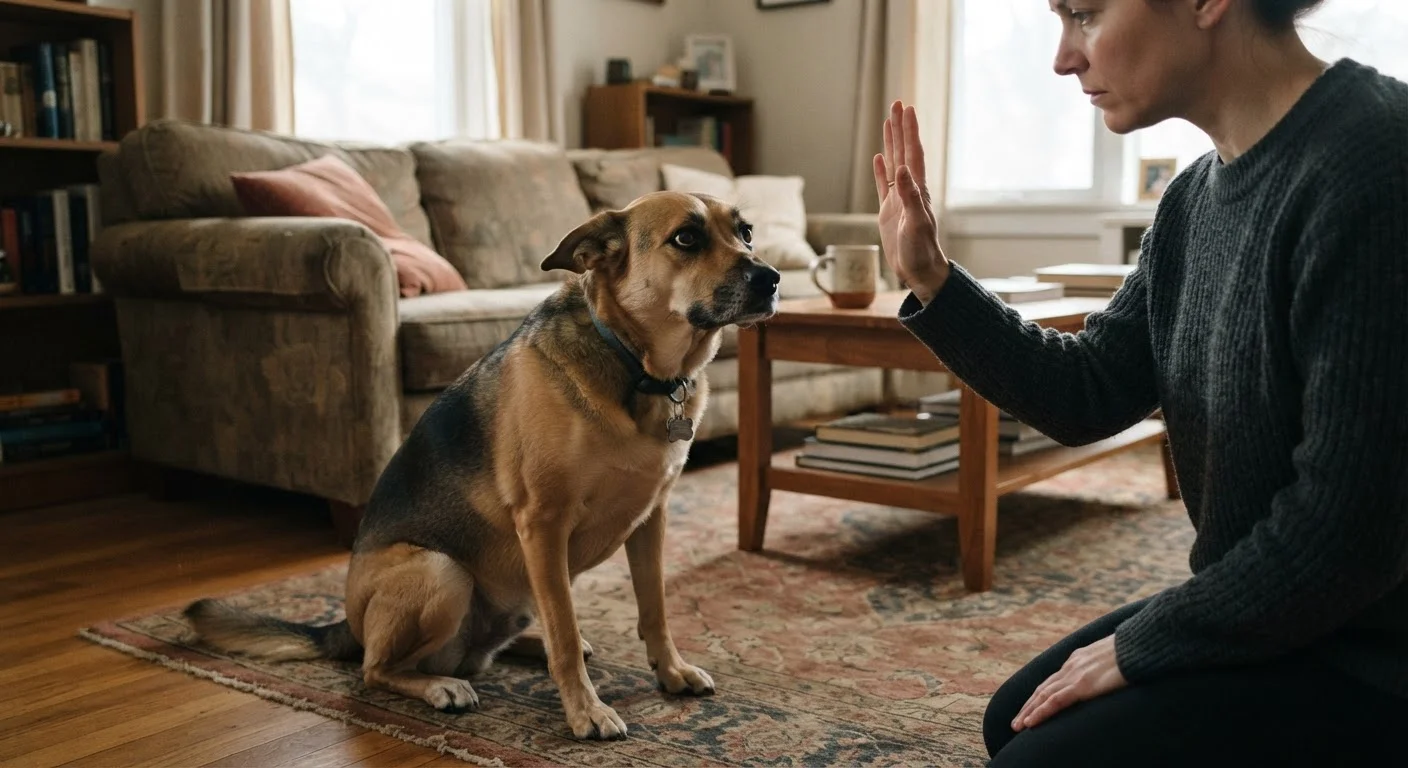

Where These Myths Come From
Many pet training beliefs have been passed down through pop culture, informal advice, and outdated science. The problem is that animal behavioral research has moved forward considerably over the past few decades, while some of the most widely repeated tips have not caught up. The result is a gap between what feels intuitive and what actually helps animals learn.
Understanding where these myths originate - and why they persist - makes it easier to let go of them. Most are not malicious; they reflect genuine attempts to explain animal behavior with the frameworks people had available at the time. But acting on them can create confusion, damage trust, and make training feel much harder than it needs to be.
Myth
You need to establish dominance over your dog to earn obedience. If your dog misbehaves, it's trying to be the 'alpha.'
Fact
Dogs are not constantly competing for social rank with humans. Behavior problems stem from unclear communication, unmet needs, or untrained responses - not dominance bids.
The dominance or 'alpha' framework became popular after early studies of captive wolves in the mid-20th century. Researchers later found those wolves were unrelated animals under stress - not a typical social unit. Studies of free-ranging dogs and wolves in natural groups show that social structures are far more fluid and cooperation-driven than the rigid hierarchy model suggested.
Professional organizations including the American Veterinary Society of Animal Behavior have published position statements discouraging dominance-based training methods, noting they can increase aggression and erode the human-animal bond. When a dog jumps on guests or pulls on a leash, it is following instinct and learned patterns - not staging a power grab. See why dogs pull on the leash for a behavioral breakdown of one commonly misread behavior.
Myth
If your pet has an accident indoors, rubbing their nose in it teaches them not to do it again.
Fact
Pets do not connect a delayed physical correction to an act they completed minutes or hours ago. The correction teaches fear, not where to eliminate.
For learning to occur, the consequence must follow the behavior within about one to two seconds. By the time an owner discovers an accident and delivers a correction, the animal has moved on cognitively. What the pet actually learns is that the owner's presence near that spot sometimes produces something frightening - which can lead to hiding to eliminate, or generalised anxiety.
Effective house training relies on supervision, predictable schedules, and rewarding elimination in the correct spot immediately after it happens. Accidents are managed, not punished. Why punishment often backfires in animal training explains the behavioral science behind why corrections without clear timing fail to produce the results owners expect.
Myth
You can't teach an old dog new tricks. Older pets are set in their ways and won't respond to training.
Fact
Dogs and many other pets retain the capacity to learn new behaviors throughout their lives. Older animals may simply need shorter sessions and clearer communication.
The brain's ability to form new associations - neuroplasticity - does not vanish with age. Older dogs can learn cues, routines, and skills using the same reward-based methods that work for puppies. Senior pets may have slower processing speeds, lower energy, or sensory changes like reduced hearing or vision that require adjustment in how cues are delivered, but these are practical considerations rather than barriers to learning.
In fact, older dogs often have longer attention spans than puppies and fewer competing impulses, which can make focused training more efficient. Keep sessions short (five to ten minutes), use high-value rewards, and build on what the dog already knows.
Myth
Repeating a command multiple times - 'Sit, sit, SIT!' - helps the dog learn what you want.
Fact
Repeating an unlearned cue trains the pet to wait for the third or fourth repetition. It teaches them the word does not mean much on the first use.
Every time a cue is repeated without a response, the word becomes less predictive and therefore less meaningful to the animal. Trainers call this 'cue nagging,' and it is one of the most common patterns that quietly slows progress. Training habits that slow your dog's progress covers this and other timing errors in detail.
A more effective approach: say the cue once clearly, wait a few seconds, and if there is no response, prompt the behavior physically (such as luring with a treat) rather than repeating the word. Once the behavior is reliably prompted, pair it with the cue again so the word gains meaning through consistent association.
Myth
Giving treats during training creates a pet that only obeys when food is present.
Fact
Treats are a teaching tool - not a permanent bribe. Once a behavior is learned, rewards can be faded to an intermittent schedule while the behavior remains reliable.
The goal of treat-based training is to reward new learning clearly and frequently at the start, then gradually shift to a variable reward schedule as the behavior becomes fluent. Intermittent reinforcement - rewarding sometimes, but not every time - actually strengthens behavior over the long term, which is the same principle behind many deeply ingrained human habits.
Pets trained with positive reinforcement methods show higher engagement and fewer stress-related behaviors than those trained primarily through correction. The treat is the scaffold - it can come down once the structure stands on its own.
What Evidence-Based Training Looks Like in Practice
Replacing outdated methods does not mean abandoning structure or expectations. It means shifting from control through force or fear to communication through clarity and reward. Modern behavioral science - rooted in operant and classical conditioning - gives owners a practical and repeatable framework. Understanding operant conditioning is a useful starting point for seeing how rewards and consequences shape behavior systematically.
In everyday training, this looks like: asking for one behavior at a time, marking it the instant it occurs (with a word like "yes" or a clicker), and following with a reward your pet genuinely values. Clicker training versus verbal markers explores how each tool works and which might suit your setup. Consistency, timing, and short sessions matter more than duration or repetition.
Delayed Corrections Confuse, Not Correct
Correcting a pet for something they did minutes ago does not teach them what went wrong - it only creates unpredictable anxiety around you. If you missed the moment, let it go. Set up the environment to prevent the same situation and be ready to reward the right choice next time.
If you are working on a specific skill like "stay," it helps to break it into smaller steps rather than expecting the full behavior immediately. Teaching a dog to stay walks through a structured approach that avoids the most common rushing mistakes. The underlying principle applies broadly: build the behavior in pieces, reward each piece, and combine them only when each is solid on its own.
This article is for general educational purposes and does not replace guidance from a certified professional animal trainer or veterinary behaviorist. If your pet shows signs of aggression, extreme fear, or distress, consult a qualified professional before attempting to address the behavior on your own.