The Two Organizations Behind U.S. Safety Ratings
When you see a safety rating on a vehicle, it almost always originates from one of two organizations: the National Highway Traffic Safety Administration (NHTSA), a federal government agency, or the Insurance Institute for Highway Safety (IIHS), a nonprofit funded by auto insurers.
NHTSA assigns vehicles a star rating from 1 to 5 across three categories: frontal crash, side crash, and rollover resistance. A vehicle earns an Overall Vehicle Score only if it scores at least 4 stars in each category. IIHS uses a four-level descriptor - Good, Acceptable, Marginal, or Poor - and tests a broader range of scenarios, including headlight performance and driver-assistance technology effectiveness.
Because these two programs use different methods and different definitions of passing, a vehicle can earn a strong result from one and a weaker one from the other. Checking both gives a more complete picture than relying on either alone.
Ratings Apply to New Vehicles as Tested
Safety ratings are assigned to vehicles as they come from the factory. Aftermarket modifications - including changes to suspension, body panels, or safety systems - can affect how a vehicle performs in a crash. Ratings also do not account for vehicle aging, deferred maintenance, or prior collision damage, all of which can degrade structural integrity over time.
What the Tests Actually Involve
Crash tests are not simply driving a car into a wall. Each test is a precisely controlled scenario designed to replicate a common collision type.
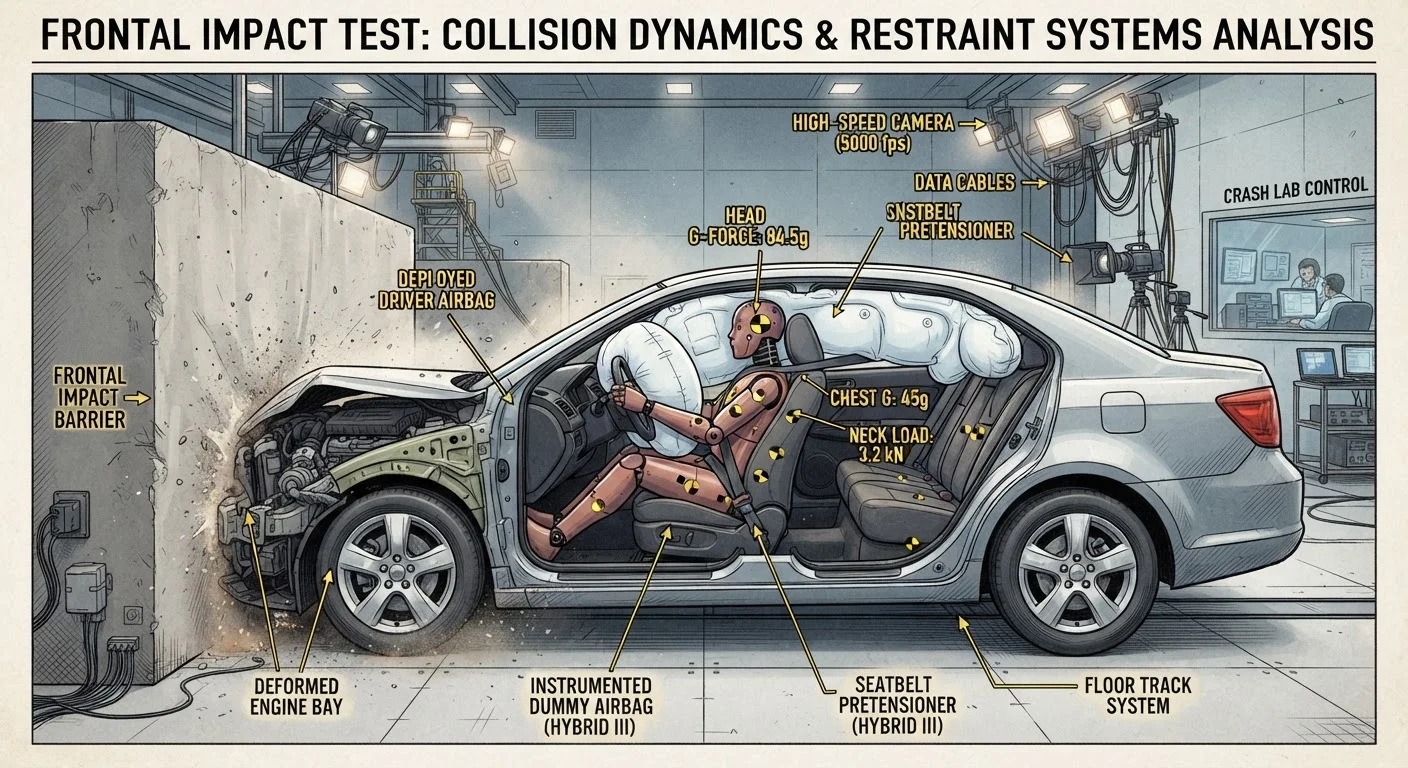
- Frontal crash (NHTSA): A full-width barrier test at 35 mph, measuring how forces are distributed through the vehicle's structure and occupants.
- Small overlap frontal (IIHS): Only 25% of the vehicle's front corner strikes the barrier at 40 mph - a scenario that often reveals structural failures hidden in standard frontal tests.
- Side crash: Both programs simulate a vehicle being struck on the side, using either a moving deformable barrier or a pole impact.
- Rollover (NHTSA): This is not a physical rollover test; it uses a calculated Static Stability Factor - essentially a measure of the vehicle's height versus its track width - to estimate rollover likelihood.
- Moderately overlapping frontal crash (IIHS): A 40% overlap barrier test at 40 mph, assessing restraint systems including airbags and seatbelts.
Crash test dummies are fitted with dozens of sensors measuring forces on the head, neck, chest, and legs. The data from those sensors produces the injury risk figures that feed directly into the final score.
Always Check Both Rating Systems
Before relying on a single score, look up a vehicle on both safercar.gov (NHTSA) and iihs.org (IIHS). Each program tests different crash scenarios and uses a different scoring scale. A minute or two spent comparing both sets of results gives you a significantly more accurate picture of how a vehicle is likely to protect you.
Safety Technology Evaluations: Beyond the Crash
Modern safety ratings extend well beyond what happens when a car hits something. IIHS introduced its TOP SAFETY PICK and TOP SAFETY PICK+ awards specifically to reward vehicles that combine strong crash performance with effective crash-avoidance technology.
To earn these awards, a vehicle must score well not only in crash tests but also in evaluations of:
- Front crash prevention: How effectively automatic emergency braking (AEB) reduces vehicle speed before a collision with another car or pedestrian.
- Headlights: Whether the vehicle's headlights illuminate the road adequately - poor headlights are a significant factor in nighttime crashes.
- Seat/head restraints: Protection against whiplash in rear-end collisions.
This matters for new drivers because a car with a 5-star crash rating but ineffective AEB or poor headlights may perform worse in real-world conditions than its top-line score suggests. Safety is a system, not a single number.
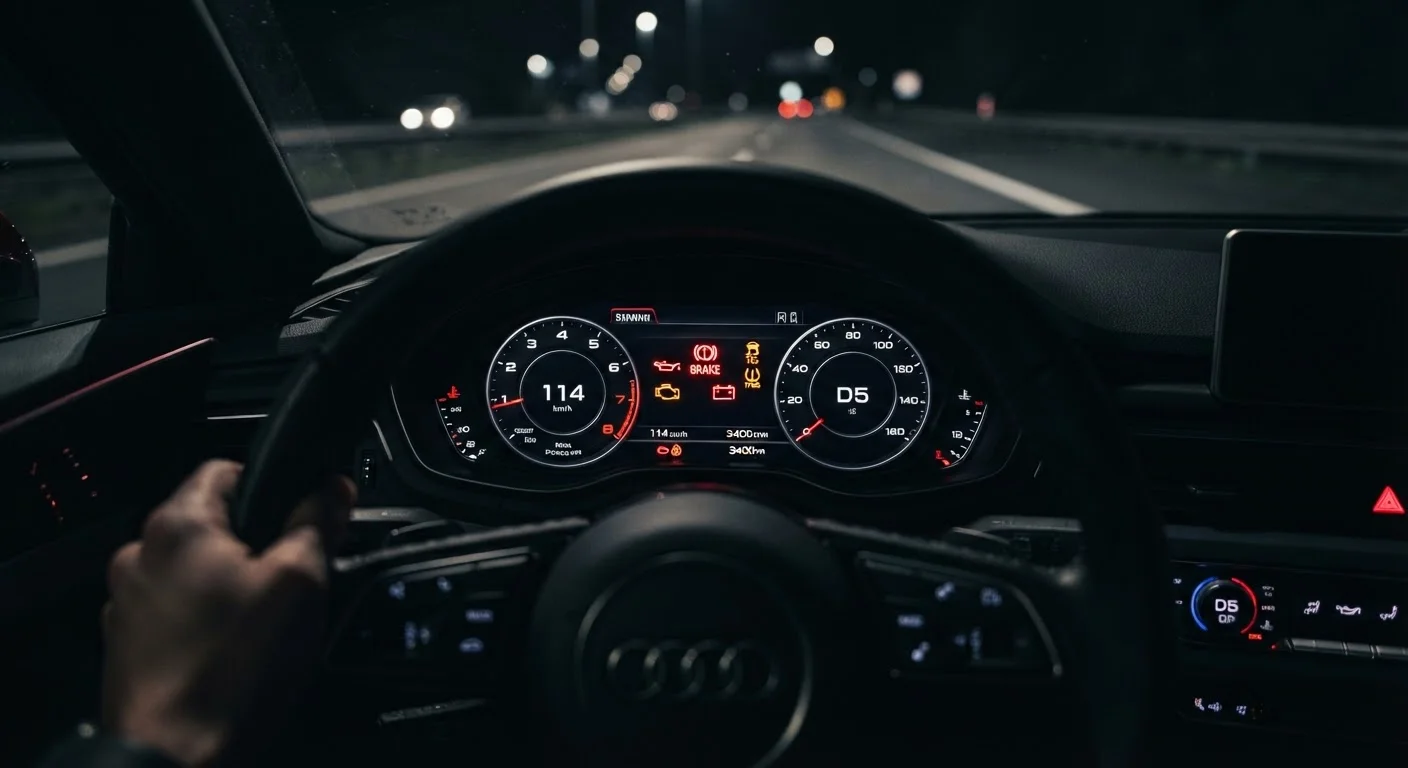
For broader context on how your car communicates safety issues while driving, see what dashboard warning lights are telling you.
38,000+
U.S. traffic fatalities in a recent year
According to NHTSA data, tens of thousands of people die in U.S. motor vehicle crashes annually, underscoring why crash safety standards matter at a population level.
40 mph
Speed used in most IIHS crash tests
IIHS conducts its primary crash tests at 40 mph, a speed chosen to represent a severe but survivable real-world collision scenario.
25%
Vehicle front width struck in small overlap test
The IIHS small overlap frontal test, introduced in 2012, strikes only the front corner of a vehicle - exposing structural vulnerabilities traditional tests did not reveal.
What the Ratings Do Not Cover - and Why That Matters
Safety ratings are a useful reference tool, but they have clear limits every driver should understand:
- They test specific scenarios. A vehicle that scores well in a controlled 40 mph frontal test may behave very differently in a multi-vehicle pileup, a rear-end collision at highway speed, or a crash involving a much larger vehicle.
- They do not account for driver behavior. Ratings measure structural and technological protection - not how a person drives. Research consistently shows that driver behavior, including speed choice and distraction, is the dominant factor in crash severity. Aggressive driving habits significantly increase risk regardless of how a vehicle scores in a lab.
- They change by model year. Ratings are not permanent. A redesigned vehicle - or even a mid-cycle update - may be retested and earn a different score.
- They do not evaluate real-world road physics. Understanding stopping distances and safe following gaps is equally important for preventing crashes before they happen.
This article is for general informational purposes only. Always consult official sources such as NHTSA (safercar.gov) and IIHS (iihs.org) for the most current vehicle-specific safety data.